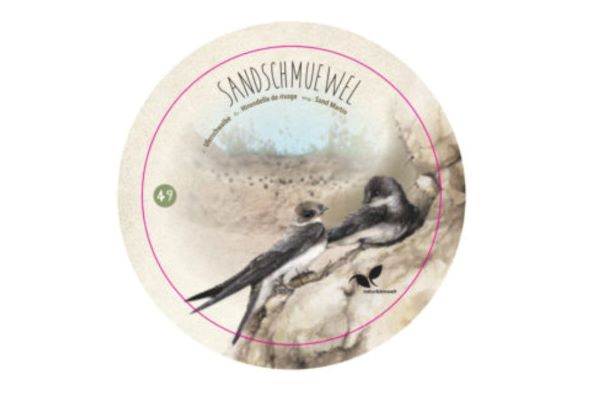
On Monday 23 February 2026, Luxembourg nature conservation NGO natur&ëmwelt asbl announced the sand martin as Bird of the Year 2026.
In Luxembourgish sand martin is known as “Sandschmuewel”. The natur&ëmwelt explained that this agile swallow nests in sandy soil, digging horizontal tunnels up to 70cm long into steep slopes. Each tunnel ends in a small nesting chamber lined with grass, wool and feathers. As sand martins breed in colonies, nesting sites often feature many entrance holes close together.
Natural nesting slopes usually form along riverbanks but river straightening has destroyed much of this habitat, leading to a shortage of breeding sites. As a result, these birds lately depend largely on artificial sand deposits, such as those found in gravel pits. An estimated 110-150 breeding pairs live in Luxembourg, mainly in the Moselle region, where sand and gravel extraction takes place. Conservation efforts also include artificial nesting walls, which have already shown promising results.
After returning from their wintering grounds in April, sand martins immediately begin excavating tunnels and breeding. Over about six weeks, they raise four to six chicks. While still feeding these fledglings, the birds often start a second brood, a behaviour known as box breeding. This strategy allows them to maximise reproduction before migrating to southern Africa in September. Migration remains the most dangerous period for the species, while drought in wintering areas and limited nesting sites continue to threaten populations, noted Natur&ëmwelt.
The sand martin measures around 12-13cm. It features a brown head and back, a white underside marked by a brown-grey breast band, dark legs and a gently forked tail. Males and females share the same appearance.
The bird’s name reflects its preferred habitat in many languages. Its scientific name, Riparia, comes from the Latin word “ripa”, meaning riverbank, which also appears in the French “Hirondelle de rivage” and German “Uferschwalbe”. The English name, sand martin and Luxembourgish “Sandschmuewel” similarly refer to sandy breeding environments.
As part of the “Bird of the Year” campaign, natur&ëmwelt offers an informative brochure and a teaching dossier with activity ideas for pupils in cycles three and four of primary education.
In collaboration with Luxembourg's National Museum of Natural History (Musée National d'Histoire Naturelle - MNHN / natur musée), a poster for students has been produced. This initiative is supported by Luxembourg’s Ministry of the Environment, Climate and Biodiversity, as well as by the Ministry of Education, Children and Youth. These materials are available in the Nature Shop in Kockelscheuer. The official sticker of the sand martin is also available in the Nature Shop or via: https://www.naturemweltasbl.lu/oiseau-de-lannee-2026/.