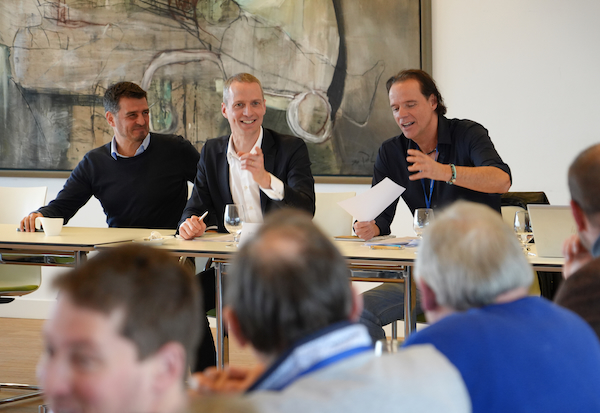
 (L-R) Gilles Biver, Senior Government Advisor, Ministry of the Environment, Climate and Biodiversity; Serge Wilmes, Minister of the Environment, Climate and Biodiversity; Claude Origer, High Council for Sustainable Development (Nohaltegkeetsrot);
Credit: MECB
(L-R) Gilles Biver, Senior Government Advisor, Ministry of the Environment, Climate and Biodiversity; Serge Wilmes, Minister of the Environment, Climate and Biodiversity; Claude Origer, High Council for Sustainable Development (Nohaltegkeetsrot);
Credit: MECB
On Friday 13 February 2026, Luxembourg Minister of the Environment, Climate and Biodiversity, Serge Wilmes, welcomed stakeholders from the hunting, forestry, environmental and agricultural sectors for the third edition of the “Bësch- a Juegddësch” ("Forest and Hunting Table”).
According to the Ministry of the Environment, Climate and Biodiversity, participants included the National Hunters’ Federation, the Lëtzebuerger Privatbësch – ASBL association of foresters, natur&ëmwelt ASBL, the Ecological Movement, the Hëllef fir d’Natur Foundation, the Saint-Hubert Hunters’ Federation of the Grand Duchy of Luxembourg, the Chamber of Agriculture, Pro Silva Luxembourg, the Nature and Forest Administration, the Superior Council for Nature Protection and the Association of Luxembourg Foresters, alongside representatives from the Ministry of the Environment, Climate and Biodiversity.
The ministry reported that during the meeting, stakeholders approved a framework agreement aimed at strengthening the resilience of forest ecosystems in the face of climate change. The central objective is to promote natural forest regeneration through more effective regulation of game populations, while improving safety, clarifying the regulatory framework and enhancing hunting practices.
The framework agreement is the result of a year-long consultation process, which included three working workshops where participants could exchange views, identify field requirements and actively contribute to defining the proposed measures.
Stakeholders acknowledged the need to adapt the legislative framework governing hunting in accordance with this agreement.
A broad consensus was reached on the implementation of the following measures:
• improving hunting resources, particularly by authorising night hunting and easing baiting regulations;
• recognising hunting as an ecological management tool for biodiversity preservation, especially for the creation of habitats such as hedgerows;
• strengthening the role of hunting associations;
• introducing a non-judicial mechanism for terminating hunting leases;
• establishing a duty of cooperation and dialogue between stakeholders regarding game damage;
• reforming the system for allocating hunting lots to give hunting associations greater freedom in tenant selection;
• implementing a system for monitoring game damage;
• democratising access to hunting to facilitate the entry of new practitioners.
Minister Wilmes remarked: “It is joint action and partnership that make the difference. This framework agreement represents an important step in collectively strengthening the resilience of our forests, essential allies in the fight against climate change and genuine reservoirs of biodiversity. By providing hunters with appropriate tools to maintain ecologically healthy game populations and supporting forest owners, we ensure the regeneration and long-term protection of our forests for the benefit of the entire population and future generations.”