 Credit: MECDD
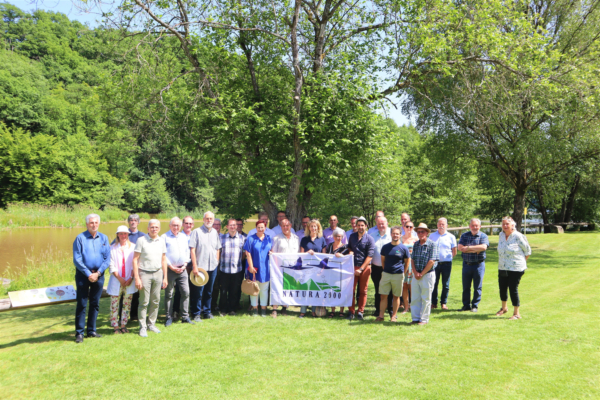
On Friday 17 June 2022, the Natura 2000 "Uewersauer" (Upper Sûre) Steering Committee representing eight Natura 2000 areas have sign a collaboration charter in Bavigne, on the edge of the "Béiweneraarm" (part of the Haute-Sûre lake), north-west of Luxembourg.
The eight Natura 2000 areas have extraordinary biodiversity, characterised mainly by the Sûre and its many tributaries, wet meadows, alluvial forests, numerous emblematic species such as the European beaver, the bistort's copper, the black stork or bats, as well as by their natural, historical and cultural heritage. To ensure sustainable management of these multifunctional spaces, with the development of very diverse and heterogeneous activities such as agriculture, forestry, drinking water production, tourism or recreational and sports activities, it is essential to involve all the main players in the sustainable management of these sites.
The main objective of the Natura 2000 Steering Committees (Comités de pilotage Natura 2000 - COPIL) is thus to create a regional, dynamic and proactive platform, allowing better involvement of local, municipal and regional actors, in order to promote the maintenance of biodiversity while taking into account the ecological, economic, social, cultural and regional requirements.
The creation of the COPILs is a concrete implementation of the amended law on the protection of nature of 18 July 2018, which plans to create eight Natura 2000 steering committees in Luxembourg.
With the signature of the collaboration charter of the Natura 2000 "Uewersauer" Steering Committee, this COPIL thus becomes the seventh to be set up after those of the “Anciens sites miniers”, “Éislek”, “Atert-Warkdall”, “Mëllerdall”, “Mamer-Äischdall-Gréngewald” and “Guttland Musel”.
The Natura 2000 network
Natura 2000 is a community network of nature protection areas created under the 1992 Habitats Directive. This network also includes areas designated under the Birds Directive and aims to ensure the long-term survival of most valuable and threatened species and habitats in Europe. Natura 2000 thus plays a key role in the protection of biodiversity in the European Union and the Natura 2000 network is even the largest network of protected areas in the world.
In Luxembourg, the Natura 2000 network currently covers 27% of the surface of the country and extends over 70,171 ha. The Natura 2000 network includes 48 “Habitats” zones (41,588 ha) and eighteen “Birds” zones (41,893 ha) which overlap in certain places.
Natura 2000 Steering Committees – a regional approach to better involve local actors
The “Uewersauer” COPIL will monitor the implementation of measures in Natura 2000 sites and will allow better coordination of the actions of local actors with those of the administrations, as well as the facilitation of the implementation of contractual measures. The advantage will indeed be to have all the regional and municipal actors concerned around a table.
The Natura 2000 “Uewersauer” Steering Committee will be chaired by Philippe Lutty, head of the Northern Region of the Water Management Administration.
The animator-manager of the sites
To support the COPIL in its missions, a specific facilitator-manager, Patrick Thommes has been employed within the Naturpark Uewersauer since March 2020.
The role of the animator-manager is, among other things, to be the contact person and the regional intermediary for all the actors concerned or interested in Natura 2000 (owners, operators, municipalities, administrations, associations, NGOs, general public, etc.). An important part of his task will be the implementation and monitoring of the planned measures. He will also take care to ensure the information and assistance of the various actors on the various possible financings.
COPIL Natura 2000 sites:
The scope of the COPIL "Uewersauer" is that of eight Natura 2000 areas for a total area of 6,305 ha:
- LU0001005 − Upper Wiltz Valley/Derenbach-Weischent
- LU0001006 − Valley of the Sûre, the Wiltz, the Clerve and the Lellgerbaach (partial)
- LU0001007 − Upper valley of the Sûre/dam lake
- LU0001008 − Middle Sûre valley from Esch/Sûre to Dirbach
- LU0001035 − Schimpach-Schimpach Quarries
- LU0001037 − Perlé-Old Slate Pits
- LU0002004 − Upper valley of the Sûre and tributaries of the Belgian border at Esch-sur-Sûre
- LU0002013 − Region Kiischpelt (partial)
The "Upper Valley of the Sûre and tributaries" site is one of the most exceptional national and European Natura 2000 sites thanks to its unique ecosystem made up of water surfaces, small watercourses and wetlands and many very varied biotopes and is therefore the COPIL's flagship site. The two former quarries at Schimpach and Perlé are two important overwintering sites for bat colonies.
The flagship species of these sites are the European beaver, the hazel grouse, the black stork and the bistort's copper, the thick mussel (small freshwater mussel) or the wild cat.
In terms of birds, the "Vallée de la Haute Sûre et affluents", which is also an area of the international RAMSAR network, is an extremely important site for a large number of species, for nesting, wintering, hunting or simply as resting place during migrations. The flagship birds of the site are the osprey, the dipper, the hazel grouse, the kingfisher or the black woodpecker. The Black Stork fishes along the many watercourses and nests in the old and calm forests, while the Hazel Grouse requires the dense forests of the old copses of oaks (Louhhecken).
The main measures to be implemented or continued will be the restoration of meadows and wetlands, in particular along the many small tributaries of the Sûre, among others, by protecting the banks and creating grassy strips; restoration of alluvial forests and conversion of softwoods to mixed forests; maintaining, developing and restoring ecological corridors and a landscape mosaic (hedges, solitary trees, flower strips, fallow land) on agricultural plateaus; the fight against invasive species; securing underground galleries as important overwintering sites for many bat colonies; the marking of biotope trees and the designation of aging islands in the forest; or the restoration of rare biotopes such as the nardaie in Mecher.
The management of visitor flows, the creation of quiet areas or the fight against light pollution as well as the information and awareness of operators, owners and the general public will be other important measures to be implemented by the COPIL. The Natura 2000 management plans for these eight areas, which include the protection objectives as well as the management measures, can be consulted online under the heading "The network of protected areas and species" via: https://environnement.public.lu/fr/natur/biodiversity.html.
The financing of the measures
The financing of the main measures will be carried out by the fund for the protection of the environment which makes it possible to finance measures of the management plans up to 100%. For measures to renature watercourses in the Natura 2000 zone, these can be financed up to 100% by the Water Management Fund. Some nature-based solutions allowing the prevention of elements linked to climate regulations can also be supported by the Climate Fund.
Further information on the Natura 2000 "Uewersauer" Steering Committee, on the Natura 2000 sites or the corresponding management plans, can be consulted by:
- the President of COPIL, Philippe Lutty (email: philippe.lutty@eau.etat.lu);
- the Natura 2000 coordinator of the COPIL, Patrick Thommes (tel.: 89 93 31 217 or email: patrick.thommes@naturpark-sure.lu);
- Mike Reckel, Ministry of the Environment, Climate and Sustainable Development (tel.: 247 86858 or email: mike.reckel@mev.etat.lu).