 Credit: Caroline Martin
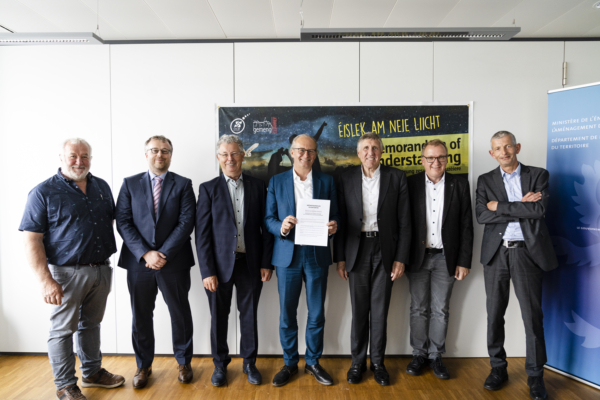
On Monday 25 April 2022, Luxembourg's Minister for Regional Planning, Claude Turmes, Minister for Mobility and Public Works, François Bausch, Mayor of the municipality of Clervaux, Emile Eicher, Director of Administration of Bridges and Roads, Roland Fox, Director of the Public Buildings Administration, Luc Dahmen, and Director of the Railways Administration, Marc Oestreicher, signed a memorandum of understanding (MoU) aimed at reducing light pollution and promoting better lighting on the territory of the municipality of Clervaux.
The anthropogenic phenomenon of light pollution has detrimental effects on nature and the environment worldwide and generates little public awareness. Science is increasingly focusing on the disturbing effects of light pollution on the environment. Artificial lighting at night accounts for a considerable share of global energy consumption, has an impact on human biorhythms and has repercussions on biodiversity. The environmental problem of light pollution shows a worrying development in Luxembourg over the past five years. The increase in artificial light emissions is mainly due to the increased use of LED technology, which is more energy efficient, but too often in a use that is not adapted to needs.
The MoU has the objectives of lowering electrical energy consumption, reducing light pollution and promoting better lighting. In a first phase, it applies to the territory of the municipality of Clervaux, a pilot municipality in terms of minimising light pollution (e.g. implementation of a masterplan aimed at minimising light pollution in Clervaux) .
The signatory parties undertake, each in its own way, to implement the various arrangements for modern lighting installations (LED) in order to substantially reduce light pollution while improving the quality of lighting on floor space and while respecting the standards and regulations applicable in Luxembourg. The memorandum can, in a second phase, be extended to other municipalities with the objective of reducing light pollution.
The added value of the MoU is to respond to user safety issues while ultimately enabling controlled, sustainable and high-quality public lighting, based on the application of guiding principles to reduce energy consumption and limit the light pollution throughout the territory. With the shared application of these guiding principles, it is also the convergence of lighting development policies that is sought in the service of the ecological and energy transition.