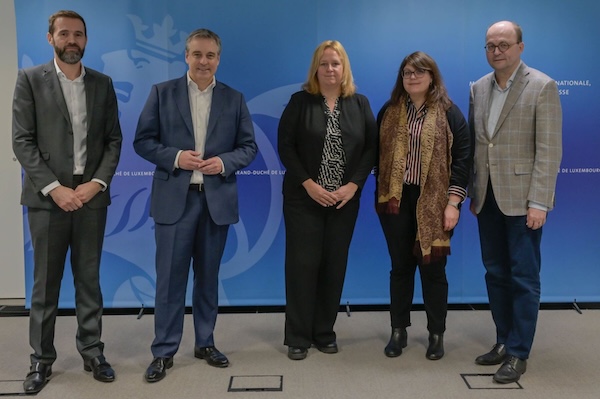
 (L-R) Claude Cardoso, Chamber of Employees; Claude Meisch, Luxembourg's Minister of National Education, Children and Youth; Tania Weber, Chamber of Agriculture; Françoise Droulans, Chamber of Commerce; Tom Wirion, Chamber of Skilled Trades and Crafts;
Credit: MENEJ
(L-R) Claude Cardoso, Chamber of Employees; Claude Meisch, Luxembourg's Minister of National Education, Children and Youth; Tania Weber, Chamber of Agriculture; Françoise Droulans, Chamber of Commerce; Tom Wirion, Chamber of Skilled Trades and Crafts;
Credit: MENEJ
On Monday 9 February 2026, Luxembourg’s Minister of National Education, Children and Youth, Claude Meisch, presented planned increases to apprenticeship allowances as well as the introduction of a new bonus for employees supervising apprentices.
According to the ministry, the measures are part of a draft law aimed at promoting vocational training and were presented at a press conference attended by representatives of Luxembourg's Chamber of Employees, Chamber of Commerce, Chamber of Skilled Trades and Crafts and Chamber of Agriculture.
“On the one hand, we are harmonising apprenticeship allowances, which currently vary depending on the training programme. This will eliminate long-standing disparities that persist between apprenticeship allowances across different trades and professions. At the same time, the introduction of a bonus for supervising apprentices within companies recognises the commitment of those involved in training and represents a tangible acknowledgement of that engagement,” explained Minister Meisch.
The need for these two measures emerged from numerous exchanges the minister held over recent months during visits to more than 20 training companies in Luxembourg.
Increased allowances
The ministry stated that, in future, the minimum basic apprenticeship allowance will be calculated as a percentage of the social minimum wage.
CCP and cross-border apprenticeship
For apprentices training towards a Certificate of Professional Capacity (CCP) or enrolled in a cross-border apprenticeship with a standard duration of two years, the ministry explained that the minimum allowance will amount to at least 45% of the social minimum wage for unskilled workers in the first year of training and at least 60% in the second year.
According to the ministry, for CCP programmes or cross-border apprenticeships with a standard duration of three years, the minimum allowance will be set at at least 45% of the social minimum wage for unskilled workers in the first year, 50% in the second year and 60% in the third year.
DAP/DT and intermediate integrated project
For apprenticeships leading to a Diploma of Professional Aptitude (DAP) or a Technician Diploma (DT), the ministry noted that the allowance will no longer increase on a yearly basis, but according to the successful completion of the intermediate integrated project, which generally takes place halfway through the training period.
Before the successful completion of this project, the ministry specified that the allowance will amount to at least 45% of the social minimum wage for unskilled workers. From the month following its successful completion, the allowance will increase to at least 60%.
In practical terms, the ministry said this means, for example, that a first-year apprentice training for a CCP as a florist assistant will receive 45% of the social minimum wage for unskilled workers or €1,216.68 per month, compared to €672.40 currently. An apprentice training for a DAP as a painter-decorator will see their allowance increase from €1,237.25 after completion of the intermediate integrated project to €1,622.24.
The ministry added that training programmes whose allowances already exceed the newly introduced thresholds will not be adjusted. This applies, for example, to the DAP programme for driving instructors, which has specific entry requirements.
To avoid any additional financial burden on employers, the ministry confirmed that the State will cover the difference between the revised amounts introduced by the reform and the allowances currently in force.
A bonus to recognise the supervision of apprentices
The ministry further announced the introduction of an annual bonus of €750 per apprenticeship contract for individuals responsible for supervising apprentices within the training company or administration.
According to the ministry, the bonus is intended to recognise the investment made by training staff in supporting young people throughout their vocational training. The training organisation will designate the staff member or members eligible for the bonus, which may be divided depending on how supervisory responsibilities are shared.
The ministry also explained that this measure forms part of the second phase of the Shape Your Future campaign, which focuses more specifically on companies. After encouraging young people to pursue vocational training during the campaign’s launch phase, the current objective is to raise awareness among companies about becoming training providers or offering additional apprenticeship places. At the same time, the campaign provides practical information on support measures, conditions and the benefits of vocational training for employers.