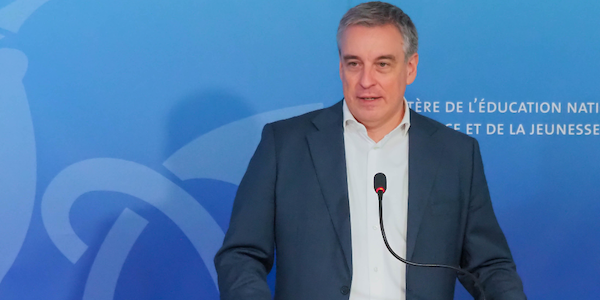
 Claude Meisch, Luxembourg's Minister of National Education, Children and Youth;
Credit: MENEJ
Claude Meisch, Luxembourg's Minister of National Education, Children and Youth;
Credit: MENEJ
On Tuesday 2 December 2025, Luxembourg's Minister of National Education, Children and Youth, Claude Meisch, presented the measures aimed at consolidating and expanding financial education within the Luxembourg school system.
According to the ministry, understanding day-to-day issues related to money, managing simple financial choices, knowing how to avoid over-indebtedness and remaining critical of digital risks are considered essential skills for developing autonomy, responsibility and economic citizenship. Financial education plays a key role in enabling pupils to acquire these competencies.
“We live in an environment in which economic and technological realities are changing rapidly. Young people are exposed very early to various financial products, often via their smartphones, without always having the necessary knowledge to make responsible choices. Growing complexity and the rapid emergence of new products require solid financial literacy today, but also a critical mindset,” emphasised Minister Meisch.
Financial education is becoming increasingly prominent in European policy, particularly through the European Financial Competence Framework for children and young people, developed jointly by the European Commission and the OECD. In Luxembourg, several initiatives in this field already exist, but they often remain occasional, the ministry reported.
To further develop young people’s financial literacy, the ministry stated that it is strengthening the place of financial education throughout the school curriculum in a coherent and progressive way, beyond one-off initiatives. The key element of this approach is a ten-point national action plan. Most of the measures will be implemented from the 2026/2027 school year.
The national action plan consists of the following ten points:
- A national financial competence framework defines the skills to be developed from cycle 1 of fundamental education up to year 1 of secondary education.
- In cycle 1, Finny, a small puppet theatre play, introduces basic notions such as recognising exchange situations, understanding that resources are limited, distinguishing needs from wants and making initial choices.
- In the curriculum for cycles 2 to 4, financial education is designated as one of the priority cross-cutting themes, meaning that pupils do not follow a separate course but address these notions through activities linked to several subjects.
- The new Piwitsch-Finanzguide magazine for cycle 4 aims to help pupils better understand money in everyday life. The ministry described this publication as being available from the 2027/2028 school year in print and digital versions, “enriched with mini-videos, quizzes, podcasts and challenges” to be carried out in class or at home.
- The EduStart-Up initiative enables secondary schools to create a school-based company, managed by pupils with support from their teachers.
- The Finanzfürerschäin allows pupils in year five and year two of secondary education to have their financial skills certified. For year two pupils, this certification will be possible from the 2027/2028 school year.
- A national charter sets out the rules of collaboration between the ministry and relevant actors in the financial sector.
- Secondary schools engaged in regular financial-education activities (workshops, projects, mini-companies, Finanzfürerschäin) can obtain the Financial Literacy Label.
- For pupils interested in economics and finance, several specialised sections already exist in Luxembourg secondary schools, allowing deeper study in this field. Schools are encouraged to develop practical partnerships, such as portfolio management, stock-market simulations and concrete projects, to better prepare pupils for higher education or direct entry into the professional world.
- A monitoring system is being implemented to continuously assess the national action plan. In addition, Luxembourg will participate for the first time in the OECD PISA Financial Literacy option in 2029.
The ministry added that the objective is twofold: on the one hand, to teach pupils to understand key notions such as inflation, loans, interest, savings or over-indebtedness; on the other, to help them develop appropriate reflexes for managing simple financial situations in daily life.
Beyond knowledge, the aim is also to create a “shared culture around money”, enabling young people to better understand the economy, make responsible choices and gain autonomy and confidence. According to the ministry, the action plan forms part of both a national and European approach; in addition to strengthening young people’s financial skills, it aims to develop economic citizenship and make society more resilient to economic challenges.