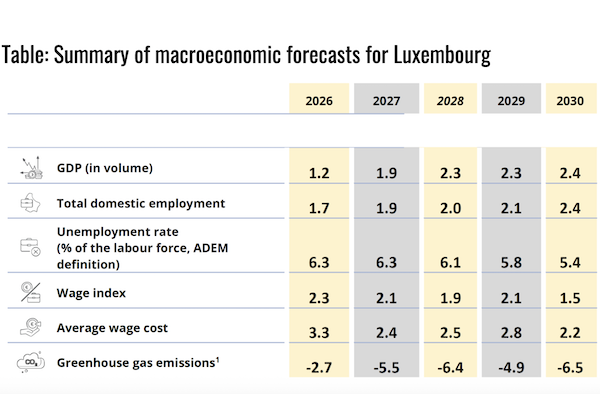
 Credit: STATEC
On Friday 9 October 2026, Luxembourg's national statistics agency STATEC published its updated medium-term macroeconomic projections for 2026–2030.
According to STATEC, Luxembourg's economy is expected to record real GDP growth of 1.2% in 2026, before gradually accelerating to 1.9% in 2027, 2.3% in 2028 and 2029, and 2.4% in 2030. In the short term, the main driver of the recovery is expected to remain exports of services, particularly financial services, while growth would increasingly be driven by the non-financial private sector in the medium term.
STATEC projected a gradual recovery in employment, with growth rising from 1.7% in 2026 to 1.9% in 2027 and exceeding 2% from 2028 onwards. However, the unemployment rate (ADEM definition) is expected to remain at 6.3% in 2026 and 2027, before declining to 6.1% in 2028, 5.8% in 2029 and 5.4% in 2030. STATEC explained that job creation in 2026 and 2027 is expected to benefit cross-border workers more than residents, without any significant downward effect on the number of jobseekers.
Inflation (CPI) is projected to stand at 1.8% in 2026 and 2.1% in 2027, before stabilising at an average of around 2% over the period 2028–2030. STATEC noted that risks surrounding this projection now appear to be skewed to the upside due to increased geopolitical tensions in the Middle East and the resulting risks to energy prices.
The institute also projected a decline in greenhouse gas emissions throughout the forecast period, with annual decreases of 2.7% in 2026, 5.5% in 2027, 6.4% in 2028, 4.9% in 2029 and 6.5% in 2030.
STATEC noted that it had updated its medium-term macroeconomic projections at the end of August 2026. These forecasts are a key element in the process of drawing up the State Budget and have been forwarded to the Ministry of Finance.
The full report is available in English here.