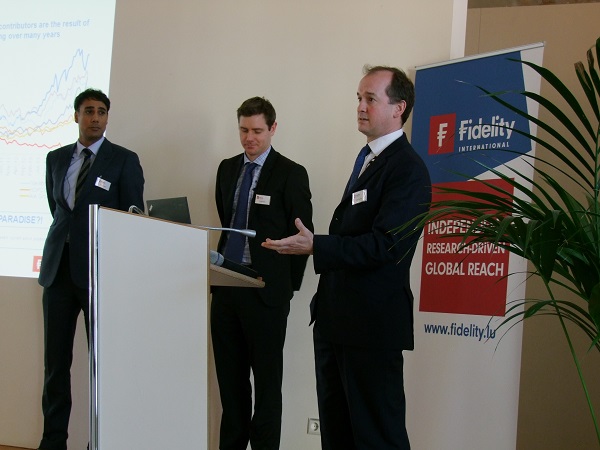
On Friday, Fidelity in Luxembourg hosted a 2016 Outlook Event at the Schéiss in Val-Ste-Croix in Luxembourg city attracting around 100 fund managers and other industry professionals.
Paras Anand, Head of European Equities, addressed the equities outlook for 2016, explained that investors need to think about scenarios that are likely to come. He believes that there is a single issue that has been evident recently, the idea of secular stagnation, in than one year may resemble another historically. Following another year of low growth and depressed inflation, the secular stagnation has gained significant mindshare. This has resulted in increased stock market volatility and a leadership characterised more by fear than greed. The next 12 months may show evidence of a "surprisingly normal" cycle at play.
Real wage growth will become the indicator monitored more and more, as the key swing factor as purchasing power increases in the aftermath of the sovereign crisis. He also sees a rise in asset price; these have been kept in check to address the solvency crisis. He expects modest inflation, also with stock volatility exceeding market volatility. He also said that the issue of productivity is argued to be lower than before, despite the advances of technology.
Unemployment is dropping and real wages are increasing, with consumer confidence rising. Growth nowadays is less sensitive to industrial production, with the service sector being much more influential.
Looking at the case for a "sideways market", he stated that the stock market has been driven by multiple expansion rather than by earnings growth and competition across the corporate sector has intensified. Company balance sheets remain robust and have money to spend but are uncertain about the economic outlook, but are using this liquidity to invest in growth in specific areas. He also explained that the financial system is now more resilient and less vulnerable to exogenous stocks.
To conclude, he stated that he expects the growth of disruptive business models will reshape the economics for many industries, and that Europe will offer particular strengths in consumer-facing businesses, with attention shifting away from innovation to markets where the playing field is more even.
Curtis Evans, Investment Director - Fixed Income, addressed the fixed income / bond markets outlook for 2016. He welcomed the recent increase in interest rates by the Fed, but expressed concern as they have been alone to do so. 2015 resulted in mixed returns for bond investors with winners and losers in equal measure: 2016 will see that diversification will be very important.
In the US, the USD Trade Weighted Index has risen around 25% as a result of tightened monetary policy. But higher rates do not necessarily mean a stronger dollar. He forecasts that the peak of the dollar strength is now behind us.
The big risk for bond markets is inflation which is expected to rise modestly this year. He also believes that 2016 will be a comeback year for credit, with fundamentals (led by the US) more stable in Europe, leading to a return of investors. The European high-yield market should be comfortable in 2016. In the US, the default rate should be around 6.6% (above Europe's). On Emerging Markets bonds he urged diversification.
Alex Homan, Investment Director, addressed the Emerging Markets in 2016 and urged less pessimism for 2016. Looking back at the past 6-12 months from a global macroeconomic perspective, the dollar weakness was helpful for Emerging Markets assets. Regarding China, he said that China has now linked the Renmimbi to a "broader currency basket" than just the USD, which he applauded. He also recognised the weakness in Emerging Markets currencies as presenting an opportunity.
On China, the economy there is undergoing an adjustment towards a consumer market; he illustrated this by presenting a brief case study of a white goods manufacturer showing significant growth; however, such stock is not immune to Chinese market volatility. He also explained the issue of non-productive capacity and presented a case study in the manufacturing sector (producing machinery for the construction sector) where account receivable days are now over 900 days, with around 300 days of inventory in stock: this is illustrative of over-supply compared to demand. Also, another case study in the steel production industry showed significant returns on Equity.
Turning to India, he said that the wide-ranging reform agenda will take time to feed through to broader economic gains. On the ground there are signs of economic improvement by consumer confidence. And South Africa and Brazil are also offering attractive opportunities in specific areas.
Photos by Geoff Thompson (top, L-R): Paras Anand, Curtis Evans, Alex Homan