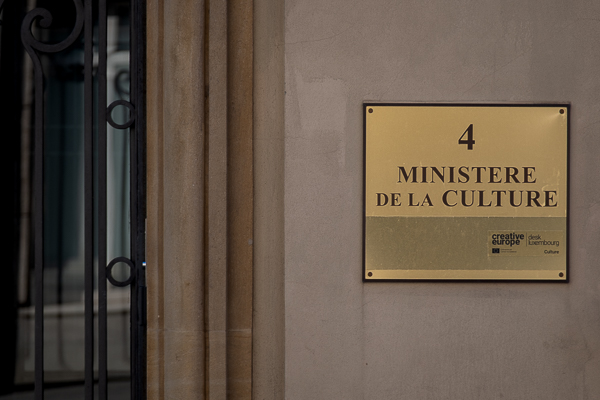
 Credit: Ali Sahib, Chronicle.lu
On Wednesday 21 January 2026, Luxembourg’s Ministry of Culture announced that the Chamber of Deputies (parliament) had approved the bill creating a Cultural Observatory (“Observatoire de la Culture”).
According to the ministry, Luxembourg thus aims to equip itself with a permanent, independent and structured instrument to strengthen the analysis, monitoring and evaluation of national cultural policies through the optimised collection and use of data relating to the cultural sector.
Under the supervision of the ministry, the Observatory will collect, analyse and publish data relating to the cultural sector. It will develop indicators and analyses to better understand developments in the sector and to identify trends and challenges. The Observatory will also monitor and evaluate cultural policies in close collaboration with relevant national and international stakeholders and will formulate recommendations based on objective and reliable data.
The creation of the Observatory follows the Kulturentwécklungsplang (KEP - national cultural development plan) 2018-2028 and responds to recommendation no 3, which calls to set up an Observatory of cultural policies. This step provides a sustainable legal basis for analytical and observational work that the ministry has already carried out in recent years.
On the occasion of the vote, Luxembourg's Minister for Culture, Eric Thill, stated: “With the adoption of this bill, we are investing in transparency, expertise and knowledge. The Cultural Observatory is not a political instrument but a centre of competence in the service of a political culture based on reliable, objective and comparable data. It will allow us to better understand realities on the ground and to develop, over the long term, a coherent, fair and future-oriented cultural policy.”
The ministry affirmed that the Observatory will carry out its missions with full scientific independence, in accordance with the provisions of the law. Equipped with its own staff framework and structured governance, it will rely in particular on a scientific advisory committee and submit an annual activity report to the government.
According to the ministry, by approving the draft law, Luxembourg’s parliament has confirmed the importance of culture as a fundamental pillar of Luxembourg society, as enshrined in Article 42 of the Constitution, and has strengthened the instruments needed to implement a sustainable, inclusive and knowledge-based cultural policy.