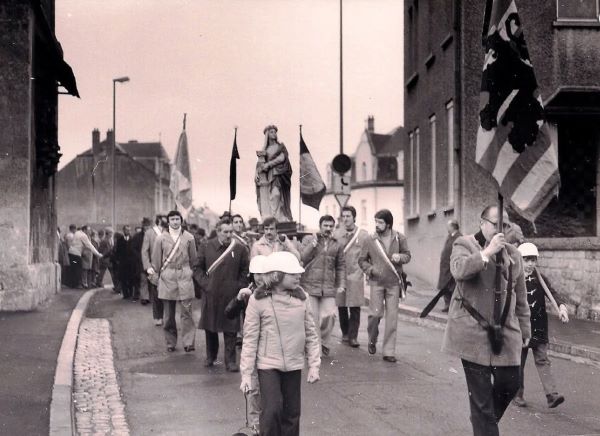
 Credit: Fausto Gardini Facebook page
At the turn of the year, Chronicle.lu will present a series on ten popular and lesser-known practices passed down through generations and preserved as elements of Luxembourg’s intangible cultural heritage.
The series draws on Luxembourg’s national inventory of intangible cultural heritage, established in 2008 to document and preserve customs, crafts and community practices that contribute to the country’s cultural identity.
The list is managed by Luxembourg's Ministry of Culture with advice from the Cultural Heritage Commission (COPAC) and aligns with the UNESCO Convention for the Safeguarding of the Intangible Cultural Heritage. It includes five categories: oral traditions and expressions; performing arts; social practices, rituals and festive events; knowledge and practices concerning nature and the universe; and traditional craftsmanship.
Marking the International Day of Intangible Cultural Heritage on 17 November 2025, the Culture Ministry announced five new additions to the list, now comprising a total of 21 elements. For more on this, see https://chronicle.lu/category/culture/57416-luxembourg-adds-5-traditions-to-national-intangible-cultural-heritage-inventory
“Bäerbelendag”
Continuing with the traditions celebrated in December, the next article in this series focuses on “Bäerbelendag” (Saint Barbara’s Day), marked on 4 December and long associated with Luxembourg’s mining and industrial heritage.
Added to the national inventory in November 2022 under the category “social practices, rituals and festive events”, the feast is linked to the legend of Saint Barbara, the patron saint of miners, and was celebrated by miners every year until the end of iron ore mining in the region.
The tale of Saint Barbara originates from the Middle East, where the day is still known as “Eid il-Burbara”. The protector of miners is believed to have lived in the third century CE. According to legend, her wealthy pagan father rejected her decision to refuse marriage and convert to Christianity. As a result, her fate was sealed: she was ultimately sentenced to death and beheaded by her own father.
Miners venerate her as a patron saint because, according to tradition, she hid in a crevice that opened miraculously in front of her while she was fleeing from her father. In addition to miners, Barbara is also the patron saint of roofers, firefighters and electricians.
Luxembourg’s Minett mining industry gradually declined after the mid-20th century and came to a definitive end with the closure of the last active mine in Differdange (Thillenberg mine) in 1981.
Although mining has disappeared, the tradition of Saint Barbara’s Day has endured. In many places, a procession is still organised on this day, during which a statue of the saint is carried through the town. Firecrackers, a church service and a banquet typically round off the celebrations.
4 December also serves as a memorial for the nearly 1,500 boys and men, aged between thirteen and 78, who lost their lives in the Minett iron ore mines. The demanding and often dangerous work carried out by miners between the late nineteenth century and 1981 played an important role in shaping the economic foundations of modern Luxembourg.
Saint Barbara’s Day has been celebrated in Luxembourg since at least the 1890s, the date found by historian Denis Klein, a board member of the National Mining Museum in Rumelange, in the first articles about the custom in Luxembourgish newspapers.
In many areas, the celebration only became an organised, paid holiday for miners in the 1920s or 1930s. In some regions, mine operators introduced this only after the Second World War. Early celebrations typically included a procession, firecrackers and a banquet, often followed by a lively gathering for the miners.
In recent years, several communities have continued to uphold Saint Barbara’s Day traditions, although, due to the COVID-19 pandemic, celebrations shrank. These include laying flowers and wreaths at former mining sites and cemeteries where miners are buried, as well as processions and holy masses organised in several towns.
Commemorations notably still take place in the south of the country, including in:
- Esch-sur-Alzette, which hosts a ceremony at the miners’ monument on Brill Square and flower laying at the monument;
- Ellergronn (Esch-sur-Alzette), where flower laying takes place at the Barbara Chapel on the former Cockerill Mine site;
- Belvaux, which hosts traditional commemorations;
- Dudelange, which holds a wreath laying in the cemetery;
- Lasauvage, which hosts a larger celebration featuring a procession carrying a statue of Saint Barbara to the entrance of the Doihl mine, followed by a mass;
- Rumelange, with a traditionally celebrated mass in the mine gallery of the National Mining Museum;
- Tétange / Kayl, where a procession moves from the cultural centre to the cemetery for flower laying at a miner’s grave, followed by a mass.
Saint Barbara’s Day is also celebrated in other Central European countries, particularly in communities with a strong mining tradition, such as Poland, Germany and Austria. Barbara remains an equally important saint within Eastern Orthodox communities.
Spanish and Portuguese explorers introduced her veneration to the Americas in the sixteenth and seventeenth centuries and the city of Santa Barbara in California is named after her.
EO