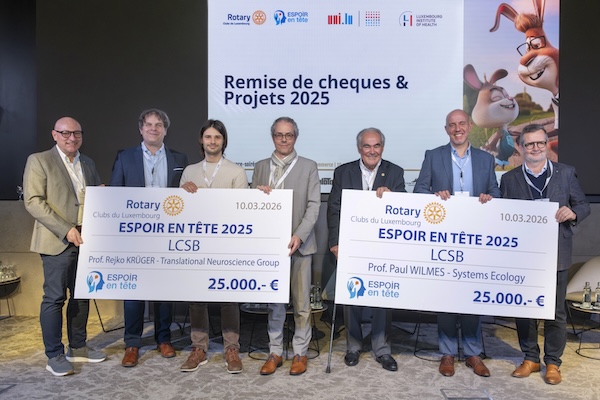
 Credit: Vic Fischbach
On Tuesday 10 March 2026, the Luxembourg Chamber of Commerce hosted the first “Espoir en tête” (hope in mind) conference, organised by the University of Luxembourg in collaboration with the Luxembourg Institute of Health (LIH), under the initiative of Luxembourg’s Rotary Clubs.
The event provided an opportunity to discuss brain diseases, in particular, neurodegenerative diseases, projects supported by “Espoir en tête”, and the importance of research funding.
Driven by Luxembourg’s Rotary Clubs, the “Espoir en tête” initiative announced a film premiere while supporting research on brain diseases such as neurodegeneration and cancer. For each cinema ticket sold at €16, €8 will go to the research in Luxembourg. Since 2024, the initiative has also supported Luxembourg’s audiovisual sector by selecting a national film.
According to the project partners, neurodegenerative diseases represent a major public health challenge. In Luxembourg, over 9,000 people are affected by Alzheimer’s disease and more than 3,000 by Parkinson’s disease. The evening offered a platform for exchange between researchers and participants and highlighted the concrete impact of donations on research in Luxembourg.
Norbert Friob, initiator of the “Espoir en tête” project and Rotary Past District Governor, opened the evening by presenting the origins of the initiative and the successes of previous editions. Philippe Lamesch, head of office of fundraising at the University of Luxembourg, then introduced the two winning projects of the 2025 edition, each supported by a €25,000 donation.
Professor Paul Wilmes from the Luxembourg Centre of Systems Biomedicine (LCSB) received support for his project on the impact of small proteins produced by the gut microbiota on nerve cells, which may open new avenues for the diagnosis and treatment of Parkinson’s disease. He noted: “Over the years, the funding allowed us to explore innovative avenues, often ineligible for standard calls for projects. The preliminary data obtained served as the basis for European and national funding applications.”
The second project, led by Iñigo Yoldi Bergua representing the LCSB and Professor Rejko Krüger, from the LCSB, Luxembourg Institute of Health (LIH) and Le centre hospitalier de Luxembourg (CHL), focuses on Parkinson’s disease in patients with high genetic risk factors. “The support from “Espoir en Tête” helps us translate scientific discoveries into concrete progress for people with Parkinson’s disease. Our project identifies ‘genetic fingerprints’ that allow us to classify Parkinson’s patients into subgroups sharing a common molecular cause - a significant step toward targeted treatments that modify the course of the disease,” stated Rejko Krüger during the ceremony.
Rejko Krüger, who also leads the “Programme for Dementia Prevention” coordinated by the CHL in collaboration with the LIH, presented risk factors for neurodegenerative diseases. He explained that addressing fourteen actionable risk factors could delay and therefore prevent up to 45% of dementia cases worldwide, and reminded the audience that people can achieve effective prevention through simple steps in daily life.
The programme included round-table discussion, featuring representatives from all institutes in Luxembourg working on brain diseases. Participants included: Simone Niclou, Vice-Rector for Research in University of Luxembourg; Frank Glod, Deputy Director in LIH; David Bouvier, NCP research unit head and Applied Neuropathology group leader at the LNS; Dimitri Budinger, postdoctoral researcher at the LCSB; and Sabrina Fritah, Head of the Cancer RNAs and Epigenetic group at LIH.
Sabrina Fritah, emphasised the decisive role of Espoir en tête in her scientific trajectory: “The support from Espoir en tête was decisive for my professional development. Thanks to this funding, I was able to obtain preliminary results that allowed me to secure a Télévie grant, enter a European competence network and now lead my own research group.”
All speakers agreed that philanthropic support is essential to complement traditional funding, noted the project partners.
“It lets us test new, higher-risk ideas and create preliminary results that are essential when applying for other highly competitive national or international funding schemes. This way, Rotary funding allows us to show that our innovations truly matter and to attract other funding,” explained David Bouvier.
“Research is like a puzzle: you advance one piece at a time. Support from Rotary helps us place those first crucial pieces,” added Dimitri Budinger.
Simone Niclou and Frank Glod stressed the importance of collaboration for biomedical research and education in Luxembourg. “Research is becoming increasingly ambitious and complex. This often requires collaboration across institutions between clinicians, researchers and patients. Rotary’s support, including for collaborative projects, helps us build them into something much larger and more impactful. This is also why the LIH, the University and all four hospitals are joining forces to create the Luxembourg Research Clinic, an initiative that will strongly facilitate clinical and translational research,” noted Frank Glod.
“In addition, we are working closely with all partners on developing a Faculty of Medicine and Health for Luxembourg,” added Simone Niclou. “Together, this will make Luxembourg a place where clinicians can combine patient care, education and research - something that will help attract young physicians back to the country and allow us to bring innovative treatments to Luxembourg,” she continued.
In looking ahead, the researchers shared a vision of a future in which Luxembourg becomes a place where cutting-edge discovery, clinical care and medical education naturally reinforce one another. They described how deeper mechanistic insights into cancer development, neurodegeneration and disease-slowing biological processes will open the door to highly personalised treatments, powered by artificial intelligence (AI) and other innovative technologies.
The evening concluded with the announcement that the 2026 “Espoir en tête” call for projects will be launched at the end of March 2026 and with the presentation of the trailer for the film of this year's conference Allez Hëpp Hopp Hopp!, an animated film directed by Caroline Origer, mainly produced in Luxembourg by La Fabrique d’Images and distributed by Tarantula Distribution, with the support of the Film Fund Luxembourg. The film is set to be premiered to the Luxembourgish public on Sunday 19 April 2026, before its national release on Wednesday 22 April 2026.