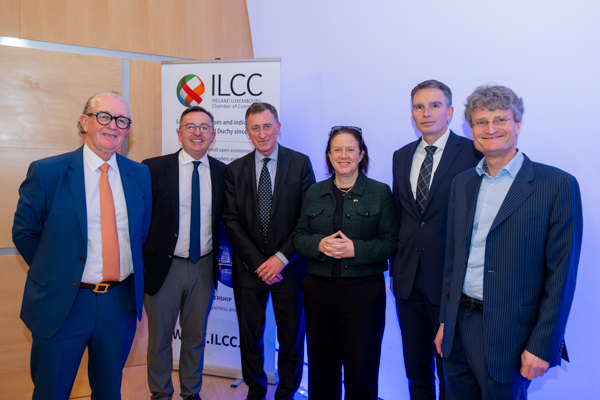
 Joe Huggard, ILCC Chairman; Brian Hayes, Chief Executive Officer, Banking and Payments Federation Ireland; Richard Meads, Business Decisions Limited; Irish Ambassador to Luxembourg Jean McDonald; Jerry Grbic, CEO of ABBL; Yann Power, Independent Director;
Credit: Ali Sahib, Chronicle.lu
Joe Huggard, ILCC Chairman; Brian Hayes, Chief Executive Officer, Banking and Payments Federation Ireland; Richard Meads, Business Decisions Limited; Irish Ambassador to Luxembourg Jean McDonald; Jerry Grbic, CEO of ABBL; Yann Power, Independent Director;
Credit: Ali Sahib, Chronicle.lu
On Tuesday 10 February 2026, the Ireland Luxembourg Chamber of Commerce (ILCC) hosted a financial services event titled "The Burden of Compliance and the Effectiveness and Unintended Consequences of AML - The Way Forward" at the premises of Banque de Luxembourg, in Luxembourg Ville.
The event examined whether current approaches to anti-money laundering (AML), including enforcement by banks and obliged entities, have triggered major negative unintended social and economic consequences and included contributions from Richard Meads of Business Decisions Limited, Brian Hayes, Chief Executive Officer, Banking and Payments Federation Ireland and former minister in Irish Government, Yann Power, Independent Director, Governance and Compliance Coach in the Fund Industry, and Jerry Grbic, CEO of the Luxembourg Bankers’ Association (ABBL).
The event began with an introductory speech by ILCC Chairman, Joe Huggard, who welcomed attendees, including Irish Ambassador to Luxembourg Jean McDonald, before introducing each of the guest speakers and providing information on each of their backgrounds.
Richard Meads then gave a keynote speech on the subject of AML and addressed the seriousness of AML as a crime, the concerns, costs and consequences of implementing AML processes, the powers available to the state to compel action, the moral purpose of AML, the consequences of unregulated credit at different levels of society and the weaponisation of misinformation through technology to influence perception of reputation, a key aspect of AML procedures.
Richard Meads emphasised: “[Money Laundering] is not a victimless crime. There are very serious predicate crimes here. Fraud, drugs, human trafficking, extortion, sexual exploitation and corruption, and financing of terrorism.”
He noted that despite the levels and complexity of existing AML legislation and procedures, “less than 1% of suspicious activity reports are ever used for prosecution […] despite the very high compliance costs and the huge scale of reporting activity. […] We need to look at all the costs. We need to look at the unintended consequences and the negative externalities that flow from the changes of behaviour of financial institutions and whether there have been incentives for additional forms of criminal activity.”
He stressed: “What we have here is a whole group of negative unintended consequences. They are behavioural changes by financial institutions in response to the incentives created by anti-money laundering rules.”
In closing, Richard Meads said: “Governments need to undertake x-positive evaluations to openly and transparently examine the causes of effectiveness and its unintended consequences. And as they design improvements, they should focus on four things: focus on outcomes, not processes; understand that you can align incentives because banks seek trust. They seek clean banking; align the incentive, the desire for trust, with the desire of government to combat crime; and be proportionate.”
Joe Huggard then invited the other panel members to provide their responses.
Brian Hayes highlighted the impact of the European Union’s (EU) response to the financial crisis in 2008-2009 and how risk reduction in the banking sector was a primary priority both in regulatory and political senses, and how this created the unintended consequences seen today in AML, such as the difficulties of older people or people who are poorer in applying for credit now from the financial sector and the moral obligations of banking institutions to utilise regulation to deter criminality but also ensure it looks after its customers and protects its customers.
He said: “I think the perennial problem we face, and it is not just today, it is in every country, is that you have a treasury department, or a department of finance in our case, and you have a department of justice, and you have a policing authority, and you have a judicial system that are not very connected with this problem. And the whole objective of AML is to try to connect up those different threads to make sure that the response is as effective as it can be.”
Brian Hayes then referenced the challenges in streamlining and simplifying the ability for institutions and regulators to share data. He remarked: “Sometimes GDPR requirements, data protection requirements, mitigate against a good response in trying to share that information, or even the topologies of that information. […] I think that is the challenge.”
In his response, Jerry Grbic also touched on the impact of the financial crisis in 2008-2009 and highlighted how this had positively brought additional regulation to the financial sector and improved the overall stability of the system. He also noted that despite being CEO of the Luxembourg Bankers’ Association, he and the association are not advocating for less regulation but for “smarter regulation”.
He remarked: “We need to understand how regulation works best, what we can do. We do not need more regulation, but we need to understand what is needed to have an impact and to have a positive output there.”
Jerry Grbic then moved on to the positive impact on Luxembourg’s reputation in the financial sector following the dissolution of the country’s banking secrecy laws in 2015, which led to a tripling of assets under management over the last fifteen years when many thought it would mean the end of the industry in the Grand Duchy. He attributed this positive trend to trust in the country’s institutions and the quality of its service providers.
He said: “If you do not trust your bank, you do not put your money there. So, we need stability in order to create trust, and in order to create trust, we need a good reputation.”
Touching on the subject of issues within the regulation and its impact on the financial sector, Jerry Grbic spoke of the issues behind the adoption of a risk-based approach and how this can generate frustration with customers because of the progressive levels of compliance questioning, information requirements and the often unique business models involving Luxembourg-based businesses who undertake regular business with customers in bordering countries.
Yann Power then gave his perspective and firstly spoke of the implications of money laundering and the use of financial sanctions and restrictive measures to combat it, as well as the complexities and inefficiencies in enforcing such measures. He said: “Failing to comply with anti-money laundering requirements or being fined for failing to comply with anti-money laundering requirements. That is bad for all of us. And then of course, yes, there is the unintended consequence of it actually being difficult to do business.”
He added: “There is the issue of we are all subject to the same rules, but actually there is very little detailed guidance about how to implement them. So, we all end up reinventing the wheel. Everybody ends up creating an AML safety compliance policy and then a risk assessment and then a risk tolerance statement. And everybody is multiplying that because there, neither is there any detailed guidance from the authorities about how it should look.”
Yann Power then moved on to the post-regulation aspects of AML and how, despite companies being responsible for identifying the risk of money laundering, terrorist financing, proliferation financing and the requirement to then communicate these details to the authorities, there is little feedback received in relation to how that information has then been used to enforce the regulations.
In closing he asked: “Can we not build a better trusting relationship with our authorities? So that it is not really a relationship of the authorities looking down and causing sanctions on us, but much more a relationship of let us share that data and improve overall the identification of crime and the mitigation of that.”
There then followed a Q&A session involving members of the audience before the event concluded with a networking cocktail with food and refreshments provided by the organisers.