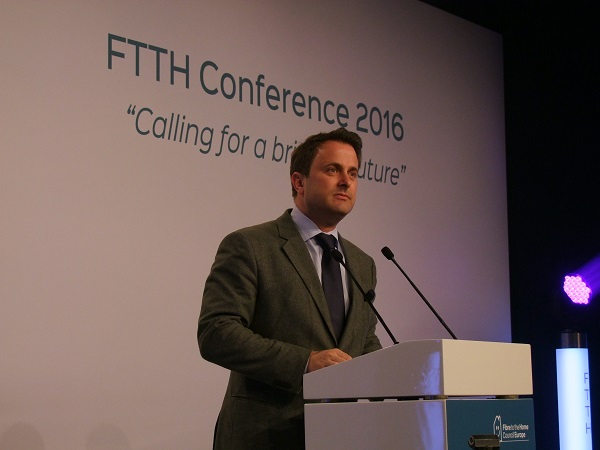
The FTTH (Fibre To The Home) Conference 2016, organised by FTTH Council Europe, kicked off at LuxExpo in Luxembourg-Kirchberg on Wednesday morning, with an overview of the status of fibre broadband connectivity through Europe and thoughts on the way ahead, with innovation driving economic growth.
Xavier Bettel, Prime Minister of Luxembourg, stated that it is a real priviledge for Luxembourg to host this conference. He talked about when travelling that one checks the level of Internet connectivity of hotels which can influence one's decision on where to stay. He recalled his time as Mayor of Luxembourg city when planning the laying of underground fibre cables and the challenges faced in doing so.
He gave a brief history of the Grand Duchy and confirmed Luxembourg was one of the 6 first founding members of the EU. It is home to the HQ of Arcelor Mittal and the RTL group, both very strong brands, as well as SES which provides Internet connectivity around the world as well as broadcasting. These allow Luxembourg to diversify its economy and allows to dramatically improve Luxembourg's international connectivity, including setting up Luxembourg's Internet Exchange.
He referred to various highly-successful start-ups in Luxembourg, including Skype. He said that the digital revolution both costs jobs and also creates jobs. "We need to have a common policy... we need people coming from other countries." In April 2010, the Luxembourg government adopted an ambitious broadband strategy which provides for ambitious targets for both downloads and uploads. At least 90% of all households in more than 50% of municipalities now have fibre broadband connectivity. 4G has been deployed inLuxembourg since 2012, but high-speed broadband needs fibre.
Deploying fibre to homes is not the final objective, it is part of the Digital Luxembourg initiative, to improve connexctivity and increase productivity. Following Luxembourg's Presidency of the EU Council in the second half of 2015, he is proud of contributing to the European Single Market by agreeing to the policy on data protection.
"We want a smart Luxembourg in a smart Europe". The infrastructure being put in place today will be really needed in a few years' time. "Let's work closer together" he concluded.
Edgar Aker, President of FTTH Council Europe, explained that the approach to increase broadband connectivity it not a narrow one, including allowing young people to accress education and eldrely people to live longer lives. Europe must take the lead in these areas. Europe needs a super-fast broadband for the future, with enless opportunities for European businesses. He mentioned a Call to Action with five pillars; FTTH is a strong advocate of competition. The countries that have seen most progress in deploying fibre are those with strong competition. Regulation should lead to easy access to infrastructure - "build it once and build it right": we need to be smart and prepare for the future.
He stated that businesses are the main users of high-speed broadband but consumers are now driving demand. Mobile broadband, including in-car services and driverless cars, all herald the connected society. He stressed the importance of load latency becoming absolutely crucial in supporting real-time solutions. He also referred to the Juncker investment plan supporting sustainable growth.
Günther H. Oettinger, European Commissioner for Digital Economy & Society addressed the conference via a video address. The Keynote Address on Inspiration was given by Ruud Hendriks, Co-founder at Startupbootcamp, talked about the nature of innovation and its affects on competition.
More than 3,000 attendees, experts in telecommunications and technology from industry, governments and academia, had registered to attend the annual conference, coming from around Europe and further afield to particiapte in the conference, workshops and exhibition.
Photos by Geoff Thompson (above): Prime Minister Xavier Bettel