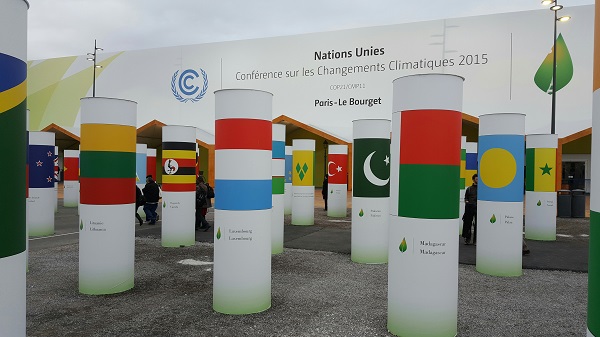
The Paris climate talks COP21 started one week ago with media-worthy opening remarks by presidents and prime ministers from all over the world; in dozens of individual sessions, hundreds of negotiators now sit together in rooms at the Paris Bourget conference site, day after day, looking at every word of a possible treaty that is supposed to come out of the conference.
At this point the goals of this years talks have become clear: lowering the announced maximum safe temperature rise from 2 degrees to 1.5 degrees, and setting the world on a path towards 100% renewable energy by the middle of the century. Both would be absolutely necessary steps to try to hold further climate change, as the last couple of years have already shown worldwide extreme weather events, even though we are still below a 1-degree temperature rise.
However as these goals become clear, the opponents of these goals have also brought their legions into place. These are mostly oil-producing countries that have a lot to lose from binding climate change goals, as their wealth and standing in the world is based on their natural resources, chiefly Saudi Arabia. Their goal in Paris: targeting diplomacy with highly skilled American lawyers, making sure that no ambitious goals make it into the final conference document. With the process of the climate conference based on consensus between all nations, hindering such announcements may unfortunately be just too easy.
Looking at the uncertain outcome of these talks, it is clear that the top-down treaty coming out of Paris will have to be supplemented from the bottom up: from individuals, from businesses and from local communities. As nations and economies struggle with the dimension of the challenges to avert climate change, solutions more often than not come from individuals and small-scale projects, rather than from politicians.
One such initiative of local communities, also present in Paris, is the KLIMABÜNDNIS, the "Climate alliance". The initiative has been going for over 25 years, and now counts 1,700 regional communities as members, 37 of which make up the "Klimabündnis Lëtzebuerg". Their goal is as clear and forward thinking as it is ambitious: reducing the release of greenhouse gases in their community by 10% every 5 years.
On a local level, the alliance informs, organizses and gives individuals the possibility to reduce their carbon footprint. They host talks and events on issues ranging from construction to transport and get involved with their regional municipalities. They are also educating the next generation which is growing up with a different understanding of climate protection – one where the crisis has arrived, rather than where it is always just around the next corner.
While a climate treaty will have to be presented and "sold" by politicians to its voters, these initiatives have the advantage of grass roots personal support by informed individuals. They are also too numerous and dedicated to be able to be stopped by a limited number of global players with their own, destructive goals.
Through their initiatives, their members are learning how to create change. They are building the know-how needed when nations eventually decide to take action. There is only so much science and the media can tell people about what they need to do, before they can start to get their hands dirty to make the planet cleaner: be it by talking to politicians, friends and family, or literally by planting vegetables in our neighbourhoods.
One group that advocates just that is INCREDIBLE EDIBLE. This group plants edible plants all over cities and communities, often replacing existing ones, which have no function and may even be poisonous. These plants, taken care of by volunteers, are then free to be consumed by anyone. The goal is to reduce greenhouse gases from transporting food over long distances, which could easily be grown locally. The trend is finding a lot of passionate support in more and more cities, and was celebrated euphorically last week in Paris at the premiere of DEMAIN – LE FILM by Cyril Dion and Melanie Laurent.
In addition to providing food, this group also creates a very in demand side product, absent from many of our communities: the possibility to connect with our neighbours, a social exchange that in many of our cities is very much in demand.
No matter what the outcome of Paris, what words will end up in the final treaty, it will only be in 2020 that this treaty will go into effect and it will probably not be enough. For those wishing to move faster and further, these initiatives provide the opportunity to be part of the solutions to problems that our generation not just needs to, but has a real possibility to deal with.
Photo by Nicolas Neuhold