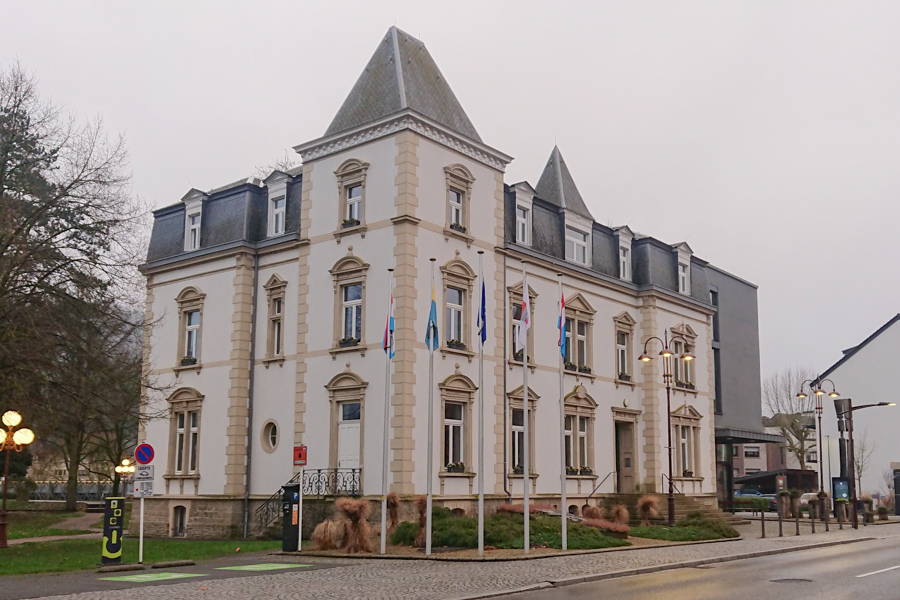
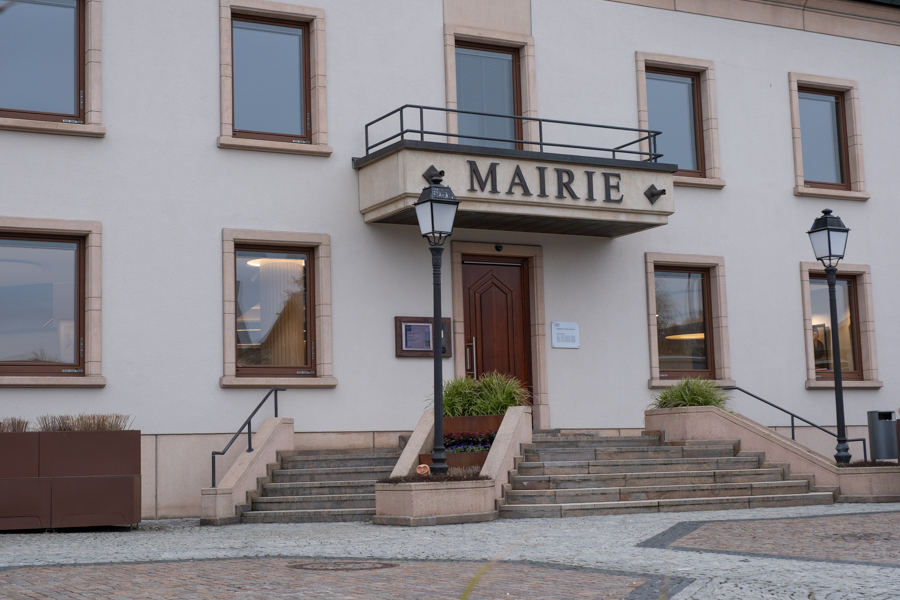
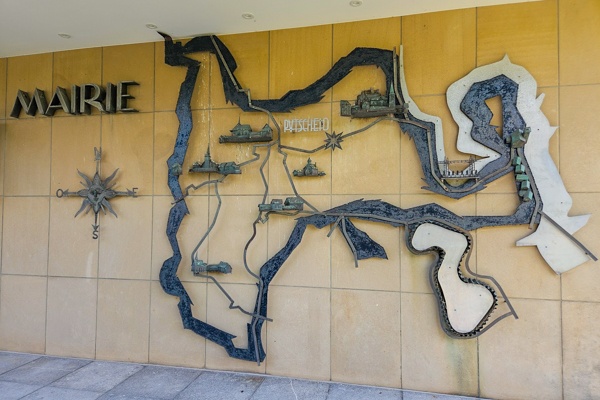
 Town Hall in Putscheid in northern Luxembourg (Canton Vianden);
Credit: Jazmin Campbell, Chronicle.lu
Town Hall in Putscheid in northern Luxembourg (Canton Vianden);
Credit: Jazmin Campbell, Chronicle.lu
Chronicle.lu has compiled a new series of articles dedicated to Luxembourg's national institutions.
This series focuses exclusively on domestic bodies and does not include European Union (EU) institutions, which will be the subject of a separate series.
The next article in the series focuses on the municipalities and municipal councils.
Municipalities & Municipal Councils
The Grand Duchy of Luxembourg has 100 municipalities (as of 2023, following two mergers), twelve of which are cities in their own right. The remaining municipalities generally consist of several towns or villages grouped together. Each municipality has autonomous jurisdiction, governed by an elected mayor, aldermen and a municipal council.
Municipalities vary in size and population. According to 2025 STATEC figures, the City of Luxembourg was the most populous municipality in the Grand Duchy, with 136,161 residents - representing about one-fifth of the country's total population. It was followed by Esch-sur-Alzette (37,922), Differdange (30,789) and Dudelange (22,203), all located in the south of the country.
At the other end of the scale, the least populous municipalities were Saeul in western Luxembourg (Canton Redange; 1,025 inhabitants), Putscheid (Canton Vianden; 1,177) and Kiischpelt (Canton Wiltz; 1,257), both in northern Luxembourg, and Fischbach in central Luxembourg (Canton Mersch; 1,306).
Every municipality has a municipal council, from which the College of Mayor and Aldermen - the executive body - is formed. The council is responsible for ensuring public order, maintaining cleanliness and hygiene and safeguarding peace in public spaces. It also oversees local public institutions and approves their budgets and financial statements. Meetings are held as needed, but at least once every three months, and are open to the public. The council publishes its decisions and agendas online.
Elections & Composition
Under Luxembourg's Constitution, municipal councils are directly elected in each municipality by residents who are eligible to vote. Voting in municipal (local) elections is mandatory for all registered voters. Since 2022, foreign residents may also register to vote in these elections, regardless of how long they have lived in the Grand Duchy.
Municipal councillors are elected every six years, with the number of councillors determined by the size of the municipality's population. Voters have as many votes as there are councillors to elect. The most recent municipal elections took place in 2023, with the next scheduled for 2029.
Number of municipal councillors (including aldermen) by population size:
- up to 999 inhabitants: seven councillors;
- 1,000 to 2,999 inhabitants: nine councillors;
- 3,000 to 5,999 inhabitants: eleven councillors;
- 6,000 to 9,999 inhabitants: thirteen councillors;
- 10,000 to 14,999 inhabitants: fifteen councillors;
- 15,000 to 19,999 inhabitants: seventeen councillors;
- 20,000 inhabitants or more: nineteen councillors.
The municipal council of the City of Luxembourg - the country's largest municipality - has 27 members. The number of councillors per municipality is set by Grand Ducal regulation, and members may be re-elected.
Municipal elections are held in two different ways: municipalities with fewer than 3,000 inhabitants use a relative majority system, while larger municipalities use a list system with proportional representation. Each municipality represents a separate electoral district.
The College of Aldermen is composed of the mayor and:
- two aldermen in municipalities with fewer than 10,000 inhabitants;
- three aldermen in municipalities with 10,000 to 19,999 inhabitants;
- four aldermen in municipalities with 20,000 inhabitants or more.
The City of Luxembourg has six aldermen.
Aldermen are appointed for six years by Luxembourg's Minister for Home Affairs upon presentation of the majority of newly elected municipal councillors. The mayor is appointed for a six-year term by the Grand Duke on the same basis.
Mayors, aldermen and municipal councillors may also hold other professional or political roles simultaneously. Private-sector employees elected to municipal office are entitled to political leave (up to 40 hours per week for mayors of municipalities with at least 6,000 inhabitants) to carry out their mandate. Those who are self-employed or do not have a profession (and are under the age of 65) receive a flat-rate allowance to compensate for time devoted to their political duties. Mayors and aldermen are also entitled to a set allowance based on the size of the municipal council, with maximum amounts determined by Grand Ducal regulation.
Competences & Services
Municipalities in Luxembourg are responsible for a range of local services and infrastructure and thus play a direct role in the daily lives of residents.
Mandatory responsibilities include: administration of the municipality, spatial planning, housing, public order, waste collection, water and power supplies, traffic and environmental policy, management of primary schools, and social assistance.
Optional tasks include: leisure and tourism, youth and senior citizen activities, and "green" (environmental) initiatives. On behalf of the government, municipalities may also perform civil registry tasks, such as issuing ID cards and registering births, deaths and marriages.
Municipalities often collaborate through associations or unions ("syndicats") to manage shared services such as waste disposal, recycling, water supplies, nature parks, public transport and leisure facilities, according to the Zentrum fir politesch Bildung.
JM/JCA