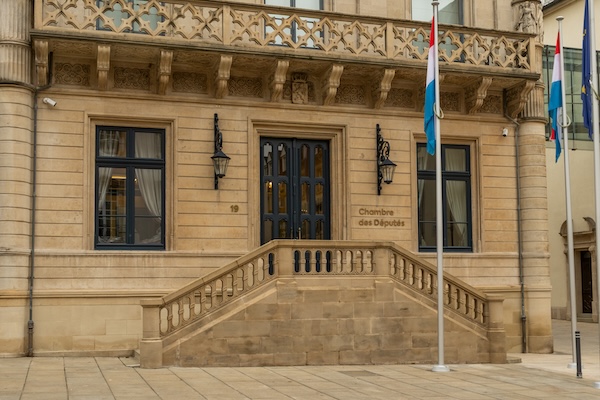
 Chamber of Deputies in Luxembourg City;
Credit: Ali Sahib, Chronicle.lu
Chamber of Deputies in Luxembourg City;
Credit: Ali Sahib, Chronicle.lu
Chronicle.lu has compiled a new series of articles dedicated to Luxembourg’s national institutions.
This series focuses exclusively on domestic bodies and does not include European Union (EU) institutions, which will be the subject of a separate series.
The next article in the series focuses on the Chamber of Deputies, Luxembourg's unicameral parliament.
In Luxembourg, legislative power is shared between the Chamber of Deputies (Chambre des Députés), the government and the Council of State (Conseil d'État). While the Chamber of Deputies and the government each have distinct roles within the parliamentary system, they work together in the legislative process.
The primary duty of the Chamber of Deputies is making legislation, i.e. voting on government and parliamentary bills, which represents its legislative power. It also monitors the government through questions and interpellations, guides political debates, and participates in European legislative and monitoring processes. The Chamber sits in the Hôtel de la Chambre near the Grand Ducal Palace in Luxembourg City, and its sessions are public. In addition to the historic building, parliamentary activities are carried out in neighbouring buildings such as Bâtiment Prinz-Richard, Bâtiment Wiltheim and the Visitor Center.
The current President of the Chamber of Deputies is Claude Wiseler (CSV), who assumed the role in November 2023. The Chamber consists of 60 deputies (MPs), elected every five years by proportional representation across four constituencies: 23 deputies come from the South constituency, 21 from the Centre, nine from the North and seven from the East. The more votes a party obtains in legislative (parliamentary) elections, the greater the number of deputies from that party are elected. Deputies are typically divided into two main groups: the majority (members of the government parties) and the opposition (all other deputies).
At the time of writing, the 60 deputies represent seven parties. The Christian Social People's Party (CSV) has 21 deputies, followed by the Democratic Party (DP) with fourteen and the Luxembourg Socialist Workers’ Party (LSAP) with twelve. The remainder are made up of five Alternative Democratic Reform Party (ADR) members, four from the Greens (Déi Gréng) and two each from the Pirate Party and the Left (Déi Lénk).
Deputies may hold other professional roles as well as other elected positions. Private sector employees are entitled to up to 20 hours of political leave per week to carry out their mandate. Political leave is also aimed at facilitating the exercise of offices such as mayor, alderman or municipal councillor. The Chamber allocates a monthly allowance to deputies, who are also entitled to attendance fees for participation in plenary sessions and committee meetings. If a deputy resigns or is unable to serve, the next eligible candidate from the same party and constituency automatically takes their seat.
The Chamber of Deputies operates under a set of texts that strictly regulate its organisation:
- The Constitution, a supreme legislative text that defines the separation of powers and the organisation of the State, and grants deputies parliamentary immunity.
- The Electoral Act, which guarantees citizens' right to vote freely and democratically in parliamentary elections.
- The Rules of Procedure, which define the organisation and operation of the Chamber (including a Code of Conduct for deputies).
The Chamber of Deputies also plays a key role in nominating members to the Council of State and the Court of Auditors (Cour des Comptes).
The Chamber has a decisive role in the legislative process. Government bills are introduced to the Chamber by the minister responsible for the matter on behalf of the Grand Duke. They are then examined by the Council of State, which provides an advisory opinion. The Chamber debates the bill, considers amendments proposed by deputies, and votes. In some cases, bills can be publicly presented during parliamentary sessions, if requested by at least five deputies.
For most laws, a two-vote rule applies: the first and second votes must be at least three months apart. Laws come into force in Luxembourg once signed by the Grand Duke and the relevant minister(s).
The Chamber of Deputies is structured into six main bodies:
- The Bureau (Executive Office) represents the institution at the national and international level, manages the Chamber's affairs and takes decisions regarding staff organisation and discipline. The Bureau also oversees financial matters and organisation issues related to deputies, parliament and parliamentary bodies. The Bureau is composed of up to fourteen members: the president, three vice-presidents, up to nine other members and six alternate members.
- The Conference of Presidents organises the Chamber's activities and proposes the agenda for parliamentary sessions. It is composed of the Chamber President and the chairs of each political group, who have a number of votes equal to the number of members of their group. The Chamber President convenes the Conference of Presidents and leads its debates. The head of government (prime minister) may attend or be represented at the Conference. The Conference of Presidents may only deliberate on a matter when the majority of deputies are present. It must be convened when two members request it.
- Political groups and "sensibilités politiques": deputies generally belong to or are affiliated with political groups. If not, they may form a technical group or express a political persuasion. The Bureau ensures that these groups and individual deputies have an appropriate working environment. Each political group must have at least five members, who are represented not only in the parliamentary committees, but also in the Conference of Presidents. They have certain advantages regarding speaking time in public sessions. For technical groups, an appointed coordinator acts as their spokesperson for administrative matters and represents them at the Conference of Presidents. The Bureau provides both political and technical groups with the premises and installations needed for their operations, as well as credits. For "sensibilités politiques" (groups of less than five deputies sharing a political persuasion) and independent deputies, the Bureau provides each deputy with a fully equipped office close to the Chamber.
- The Presidency is the function exercised by the president and three vice-presidents, who represent the Chamber of Deputies and lead its debates. The president is responsible for maintaining order, ensuring the Rules of Procedure are followed and determining whether or not the texts, motions or other proposals are admissible in their current form. He/she also gives the floor and delivers the decisions of the Chamber. If the president wishes to participate in a discussion, he/she must be replaced in the Presidency. If unable to attend, one of the vice-presidents performs the president's duties (interim).
- The Committees are tasked with examining government bills as well as private member’s bills, amendments and motions referred by the Chamber President. They may also present their own amendments and proposals. Other tasks include preparing debates and organising hearings. Parliamentary committees consist of five to fifteen members. They generally set their own agenda for their work. Most parliamentary committee meetings are livestreamed on the Chamber's website.
- The Parliamentary Administration carries out a range of tasks, with the aim of "serv[ing] the Chamber of Deputies, the deputies and democracy", according to the Chamber website. It primarily supports deputies in fulfilling their duties and helps ensure the Chamber's democratic legitimacy by contributing to its visibility and accessibility. The administration consists of over 165 officials and salaried employees.
JM/JCA