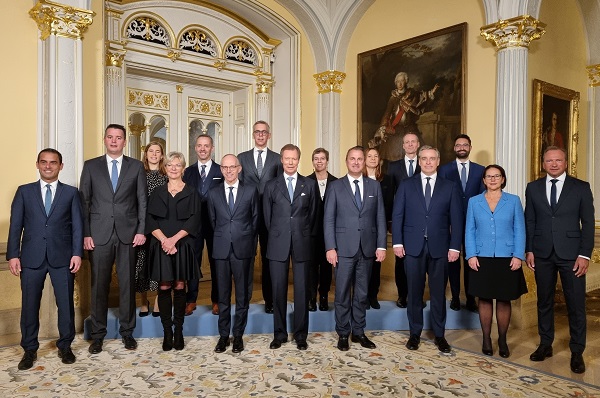
 CSV-DP coalition government sworn in on 17 November 2023;
Credit: Jazmin Campbell, Chronicle.lu
CSV-DP coalition government sworn in on 17 November 2023;
Credit: Jazmin Campbell, Chronicle.lu
Chronicle.lu has compiled a new series of articles dedicated to Luxembourg’s national institutions.
This series focuses exclusively on domestic bodies and does not include European Union (EU) institutions, which will be the subject of a separate series.
The first article in the series focuses on the Luxembourg Government and the Government Council (Cabinet).
Government
As a body exercising executive power, the government is responsible for managing public affairs and upholding laws, regulations, decrees and public order. The government also takes legislative initiative, by drafting government bills (projets de loi). It oversees the administration of state assets and manages the state's expenditure and revenue budgets, reflecting the executive power vested in the government by the Constitution.
The current government consists of fifteen ministers, including the Prime Minister, a position occupied by Luc Frieden since the October 2023 legislative elections, and the Deputy Prime Minister, Xavier Bettel, who previously served as prime minister. The remaining ministers are appointed to specific ministerial portfolios.
The Constitution stipulates that the Grand Duke may freely appoint the prime minister and ministers. In practice, however, his power is exercised in accordance with the outcome of the legislative elections. The appointed prime minister must be able to win the confidence of a parliamentary majority, which requires at least 31 out of 60 deputies (MPs) in the Chamber of Deputies (Chambre des Députés). The Grand Duke respects the legislative election results by designating a prime minister who is capable of forming a government and presenting a programme that meets the expectations of the parliamentary majority.
Ministers must be Luxembourg nationals and their office is incompatible with holding other public posts or professional activities. The Constitution does not set the duration of ministerial mandates; however, the Grand Duke may dismiss ministers at any time, usually on the advice of the prime minister.
If no single party holds an absolute majority in the Chamber of Deputies, the political parties may form a coalition government by negotiating a joint government programme. Since November 2023, Luxembourg has been governed by a coalition between the Christian Social People's Party (CSV) and the Democratic Party (DP), led by Prime Minister Luc Frieden.
The legislative process involves several institutions. Government bills are drafted by the competent ministry and approved by the Government Council (Conseil de Gouvernement) before being submitted to the Council of State (Conseil d’État) for its advisory opinion. Once the opinion has been delivered, the bill is debated and voted on by the Chamber of Deputies.
Government Council
The Government Council, commonly referred to as the Cabinet, is the collective decision-making body of the government. It meets on a weekly basis at the Ministry of State, bringing together all ministers to deliberate on matters of government policy and bills to be submitted to the Chamber of Deputies. The prime minister determines the agenda. Members vote on internal regulations and decisions are taken by majority vote. In the event of a split vote, the prime minister's vote is decisive. The work of the Government Council is supported by the Secretary General of the Government, a department overseen by the prime minister of Luxembourg.
Current Government Members
- Luc Frieden (CSV), Prime Minister
- Xavier Bettel (DP), Deputy Prime Minister, Minister for Foreign Affairs and Foreign Trade, Minister for Development Cooperation and Humanitarian Affairs
- Marc Spautz (CSV), Minister of Labour (since December 2025)
- Martine Hansen (CSV), Minister of Agriculture, Food and Viticulture, Minister for Consumer Protection, and (since December 2025) Minister of Sport
- Claude Meisch (DP), Minister of Education, Children and Youth, Minister of Housing and Spatial Planning
- Lex Delles (DP), Minister of the Economy, SMEs, Energy and Tourism
- Yuriko Backes (DP), Minister of Defence, Minister for Mobility and Public Works, Minister for Gender Equality and Diversity
- Max Hahn (DP), Minister for Family Affairs, Solidarity, Living Together and Reception of Refugees
- Gilles Roth (CSV), Minister of Finance
- Martine Deprez (CSV), Minister of Health and Social Security
- Léon Gloden (CSV), Minister for Home Affairs
- Stéphanie Obertin (DP), Minister for Digitalisation, Minister for Research and Higher Education
- Serge Wilmes (CSV), Minister of the Environment, Climate and Biodiversity, Minister for the Civil Service
- Elisabeth Margue (CSV), Minister of Justice, Minister Delegate to the Prime Minister for Media and Connectivity, Minister Delegate to the Prime Minister for Relations with Parliament
- Eric Thill (DP), Minister for Culture, Minister Delegate for Tourism
Oversight & Responsibility
Government action in Luxembourg is subject to both internal and external oversight mechanisms. Internal control structures include the Inspectorate General of Finance (IGF), financial control bodies and specialised advisory and supervisory institutions such as the Consultative Commission on Human Rights (CCDH), the National Commission for Data Protection (CNPD) and the Ethics Committee. External oversight is exercised by the Chamber of Deputies, the Court of Auditors (Cour des Comptes) and the Ombudsman (Médiateur).
Ministers bear political responsibility before the Chamber of Deputies and may also incur civil or criminal liability under specific legal circumstances. Government policy is implemented through instruments such as the government declaration at the beginning of each mandate, the annual "State of the Nation" address, consultation debates and action plans.
JM/JCA