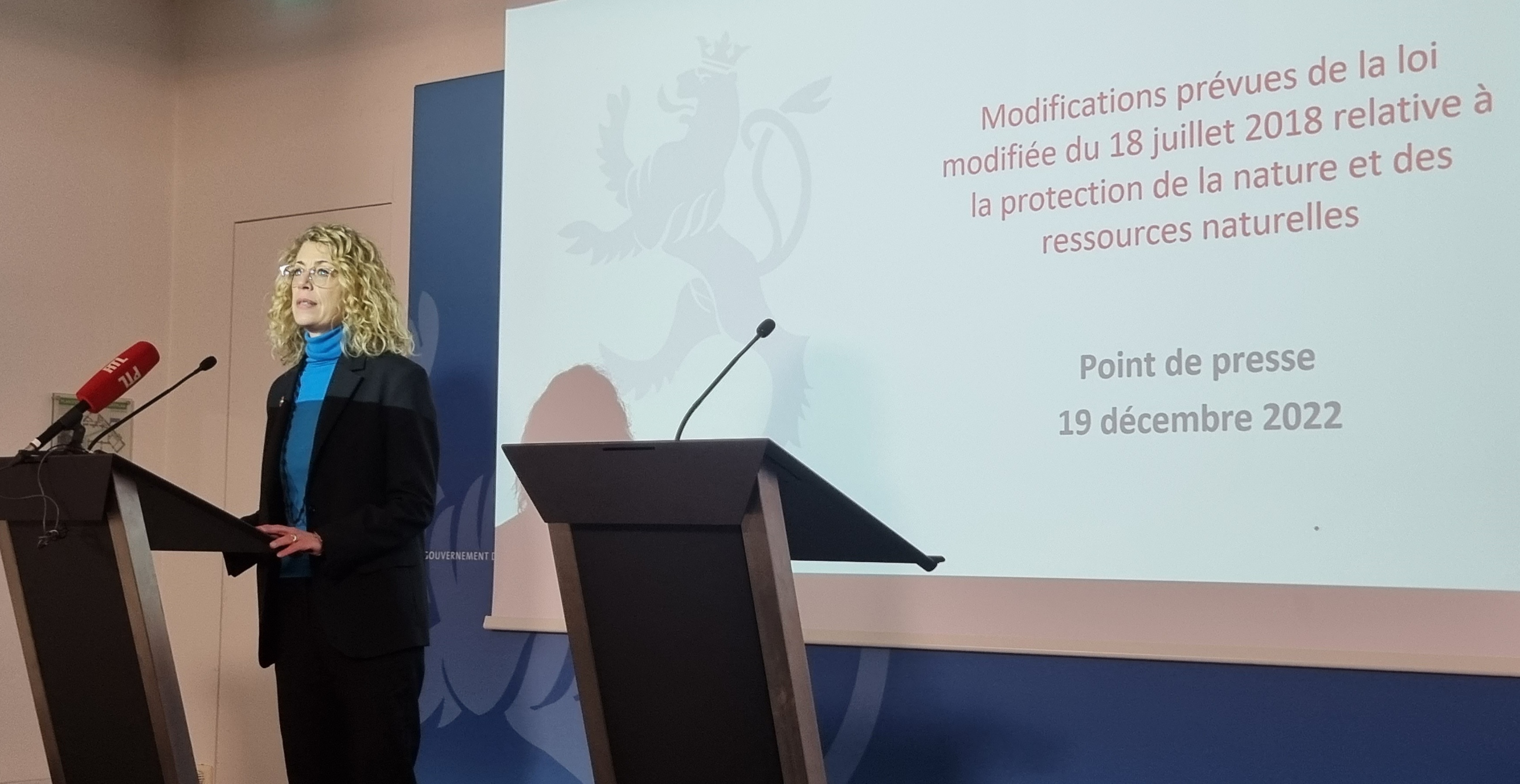
 Minister Joëlle Welfring;
Credit: MECDD
Minister Joëlle Welfring;
Credit: MECDD
Luxembourg's Ministry of the Environment, Climate and Sustainable Development has announced proposed amendments to the amended law of 18 July 2018 on the protection of nature and natural resources across the Grand Duchy.
On Monday 19 December 2022, the Minister for the Environment, Climate and Sustainable Development, Joëlle Welfring, presented details of the bill which was approved on 14 December 2022 by the Government Cabinet.
This bill aims, among other things, to amend the law in order to (a) adapt the legislative text to reflect recent case law in this area, and (b) to reduce administrative burdens, while guaranteeing a high level of protection of nature and natural resources.
The minister emphasised that this bill does not provide for any additional limitations or prohibitions compared to the current law which has been directly applied both in authorisation requests and in ongoing legal cases.
New opportunities for thermal sanitation works, security works and constructions and reconstructions
The draft law provides for constructions erected before 1 July 1995, the date from which the ministry has had an electronic register of authorised constructions and works, that address:
- All legally existing constructions can carry out thermal sanitation to adapt their constructions to current urban planning standards.
- Raising slabs and rooves of legally existing constructions – and therefore increasing the height of the construction to adapt their constructions to current urban planning standards – is now authorised within certain limits.
- In addition, the bill specifies that security works and constructions can now be authorised.
- Reconstructions – new provisions in the bill: all constructions destroyed by a fortuitous event can now be rebuilt identically without time limit; and other buildings can be rebuilt under certain buildings.
Currently, such reconstruction is only possible for constructions covered by article 6 and for habitual residences destroyed by fortuitous events within two years.
All this work remains subject to authorisation.
Fewer administrative burdens: an authorisation is no longer necessary for interior works that have no impact on the exterior appearance of an existing building
The draft law provides that in the future, interior modifications - for any legally existing construction - are no longer subject to authorisation provided that they do not lead to a change in the external appearance or a modification of the construction dimensions.
Fewer administrative burdens: additional elements that can be built without permission
According to the bill in question, certain elements no longer require authorisation since their environmental impacts, in general or depending on their location, are foreseeable and minor. For example:
- certain types of fences,
- certain photovoltaic installations and their related installations,
- certain tunnel hives and greenhouses,
- temporary shelters erected during heat waves to protect grazing animals,
- small constructions relating to hunting,
- certain small tools for sound or visual recording,
- artificial nesting boxes and perches for wild birds and bats.