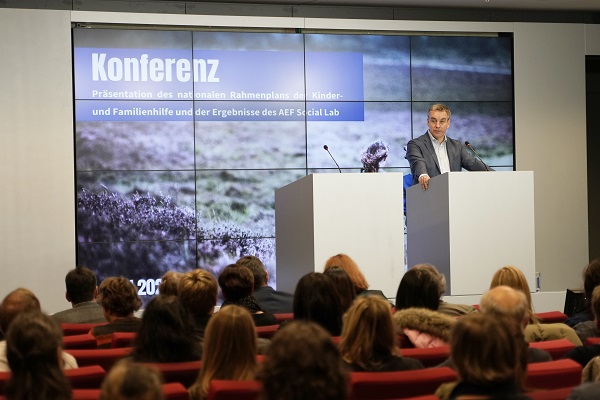
 Claude Meisch, Luxembourg's Minister of Education, Children and Youth;
Credit: MENEJ
Claude Meisch, Luxembourg's Minister of Education, Children and Youth;
Credit: MENEJ
Luxembourg's Ministry of Education, Children and Youth recently presented the very first national reference framework for child and family assistance.
This document intends to contribute to harmonising the intervention framework of professionals by referring to the main principles as formulated in the United Nations Convention on the Rights of the Child (UNCRC), defining reflective professional practices and defining common evaluation criteria. It aims to provide each child, young person and family the best possible support when needed, whether it is family assistance, a psychological consultation, outpatient measures, socio-educational support or a stay with a host family.
In his opening speech, Luxembourg's Minister of Education, Children and Youth, Claude Meisch, emphasised that with this framework “a great step has been taken in the development of the quality of services to help children and young people. It is precisely where children, young people and families experience difficult situations that quality is even more essential. The reference framework allows us to make the rights of the child a reality”.
The services and measures of the "Aide à l'Enfance et à la Famille" (AEF) platform have multiplied in recent years, making the adoption of a common framework even more necessary. In 2020, 1,280 children and young people benefited from an accommodation measure, including 1,000 following a judicial placement. 800 young people were accommodated in boarding schools or in supervised accommodation. The platform also helped with 7,600 outpatient measures.
The national reference framework is the result of wide consultation both with AEF professionals and the beneficiaries themselves. Launched in autumn 2020 as part of the AEF Social Lab, this participatory process made it possible to gather the different voices during more than 40 events.
The key role of the framework will be confirmed in the future law reforming youth protection, which is currently in preparation.
In the immediate term and in the months to come, exchanges and training will be offered to deepen the various dimensions of the framework and to establish educational guides using a collection of good practices. The framework is intended to be a living, evolving document, in constant progress according to changes in society, the experiences of professionals and the needs of families.