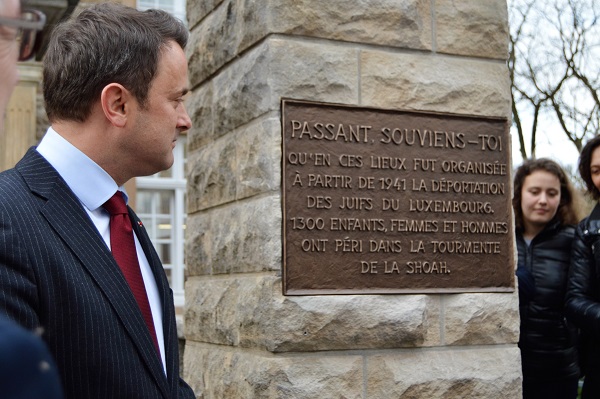
A plaque was inaugurated outside the Villa Pauly Wednesday afternoon to remind passers-by and the general public of the building's history as the former headquarters of the Gestapo during World War II.
The building at N°57 boulevard de la Pétrusse was originally constructed for a surgeon, Dr. Norbert Pauly, who established his medical practice in the basement in 1923. Dr. Pauly was out of the country when Luxembourg was occupied by the Wehrmacht on 10 May 1940, and the Villa Pauly fell into the hands of the Gestapo, and the underground area that was originally intended to provide care became a source of terror when it was transformed into an interrogation and torture chamber.
Individuals suspected of anti-German conduct were brought to the building to be interrogated, with many suspended upside down from heating pipes or beaten with whips. What had once served as a medical practice became a gateway to concentration camps, where the deportation of Jews living in Luxembourg was organised and a fresh hell for them began.
During the liberation of 10 September 1944, several individuals set fire to the papers left behind by the Gestapo, but the building itself was saved by firefighters and became the offices of the Counter Intelligence Corps (CIC) of the American Army. The Luxembourg State later took over the building and established several Ministries there but the Villa Pauly continues to serve as a reminder of the terror and suffering inflicted on those unlucky enough to pass across its threshold during the Nazi occupation.
Therefore in 1984, during the commemoration of the 40th anniversary of the liberation, then Minister of Health and a former resistance fighter himself, Emile Krieps; Prime Minister, Pierre Werner; and Deputy Prime Minister Colette Flesch unveiled a commemorative plaque on the pillar outside the entrance of the Villa Pauly.
On the occasion of the Holocaust Memorial Day 2016, Prime Minister Xavier Bettel joined the Director of the Centre de Documentation et de la Recherche sur la Résistance (CDRR), Paul Dostert, in unveiling a new plaque to remind the Luxembourg public of the tragedies that the Grand Duchy underwent and overcame. The Prime Minister spoke of the importance in remaining conscious of these atrocities and of the individuals upon whom they befell.
"Even if they are no longer here, or fewer in numbers, it is up to us to preserve their presence in daily life," Xavier Bettel stated, before quoting Elie Wiesel: "To forget the dead would be akin to killing them a second time."
The new plaque reads (translated from French):
'In passing, remind yourself
that it was on these premises that was organised,
from 1941, the deportation
of Jews from Luxembourg.
1300 children, women, men perished
in the torment of the Shoah'.
Photos by Sarah Graham