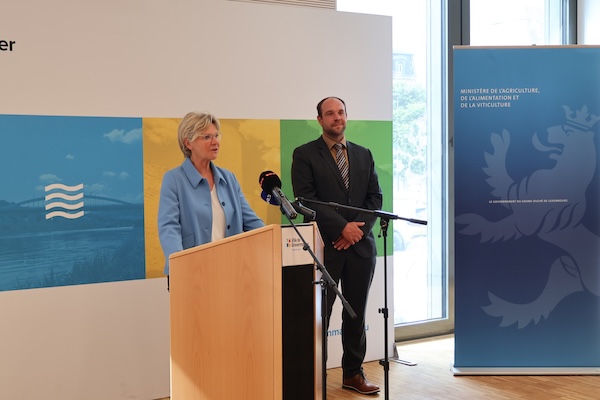
 (L-R) Martine Hansen, Luxembourg’s Ministry of Agriculture, Food and Viticulture; Christian Hahn, President of Luxembourg’s Chamber of Agriculture;
Credit: MA
(L-R) Martine Hansen, Luxembourg’s Ministry of Agriculture, Food and Viticulture; Christian Hahn, President of Luxembourg’s Chamber of Agriculture;
Credit: MA
On Friday 5 June 2026, Luxembourg’s Ministry of Agriculture, Food and Viticulture Martine Hansen brought together representatives of the agricultural, wine-growing and horticultural sectors in Grevenmacher for the third edition of the "Landwirtschaftsdësch" (agriculture round table).
The meeting marked the launch of the consultation process for preparing the implementation of the future Common Agricultural Policy (CAP) after 2027 and the development of Luxembourg's next agricultural law.
According to Luxembourg’s Ministry of Agriculture, Food and Viticulture, Minister Hansen in her opening address stressed her intention to build this future legislative framework in close cooperation with the sector. The objective is to jointly define the directions that will strengthen the resilience of Luxembourg agriculture in the face of economic, climate-related and geopolitical challenges in the coming years, while preserving its competitiveness and sustainability. In this context, food security and Luxembourg's ability to maintain strong and diversified agricultural production were identified as key issues.
"Our objective is to establish a framework that reflects realities on the ground and supports Luxembourg agriculture in a sustainable manner while respecting the European framework imposed on us. Family farms, generational renewal and diversification of agricultural production are essential priorities. The earlier we set the course, the better we can prepare the future of our agriculture, especially as European financial resources may become more limited from 2027 onwards and it will be necessary to target support measures more effectively so that they have the greatest possible impact on the ground. This first consultation has enabled us to identify what is working well today and the areas where adjustments could be considered as part of the future agricultural law," said Minister Hansen.
The ministry noted that discussions focused on the main support instruments available to the agricultural sector and possibilities for adapting them within the future European and national framework. Participants reviewed existing measures, identified their strengths and shared expectations regarding future developments.
Participants paid particular attention to the targeting of public aid beneficiaries and discussed ways to improve the effectiveness of public support in order to better meet sector needs and support the development of agricultural holdings.
Participants also identified support for young farmers and new entrants as a priority for the coming years. They discussed ways to strengthen certain production sectors and better promote the diversity of agricultural models in Luxembourg. They also examined possible changes to coupled support payments within the future support framework. Proposals included maintaining support for suckler cows and legume crops, as well as targeting assistance more effectively towards fruit and vegetable production.
The meeting represented a first step in the consultation process. Discussions will continue in the coming months through further meetings with sector representatives in order to refine the orientations that will be included in the future agricultural law, noted the ministry.
"The challenges facing our agriculture require solutions developed together with the sector. We welcome the willingness to begin this reflection process early enough to build a framework adapted to the realities of farms and the expectations of farmers. In the current context, it is more important than ever to support a strong and productive agricultural sector in Luxembourg, capable of fulfilling its primary mission: producing quality food and contributing to our food security," concluded Christian Hahn, President of Luxembourg’s Chamber of Agriculture.