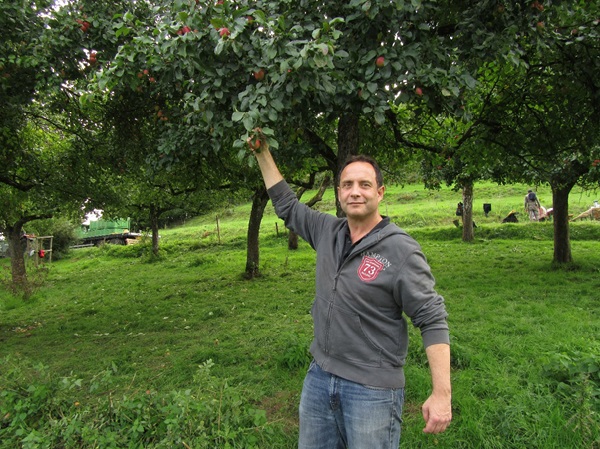
At the week-end, in the hills of the Lower Sûre Valley above the picturesque village of Born, the bright early Autumn air rang to the sounds of tractors and laughter as Ramborn Cider started the harvest of the apples which go to make up their distinctive and unique Luxembourgish cider; as is usually the way with apple trees, a good year follows a bad year, and this year is most certainly a good one.
Gérard Bisenius from Ramborn told The Luxembourg Chronicle that they had expected that the hot summer would contribute to the apples ripening earlier, which had not in fact happened but, as Carlo Hein added, the amount of juice being extracted amounted to an exceptional 60% of the apple weight, which will contribute to a particularly high yield.
Over the course of the next week or two, nearly two million apples will be harvested to provide 120,000 litres of apple juice and about 60 tons of pulp which will be send to Flaxweiler for recycling into bio gas. In contrast, last year, their first year of production, saw them struggle to collect enough apples to produce 16,000 litres of juice. Of the other major changes that have taken place over the last twelve months, the most significant revolve around the transformation of the humble apples into the finished product which will appear on the shelves of local supermarkets, cafés and restaurants.
Last year the finishing and bottling was done in England, but this year the entire process will take place within the borders or the Grand Duchy. Ramborn have invested significantly in their own portable press, which incorporates loading, washing, feeding, pressing, vatting and waste pulp extraction stations and can comfortable extract 8,000 litres of apple juice per day. Thereafter the juice will be transported to VinsMoselle for fermentation and subsequent bottling. According to Ramborn’s Gilles Dimmer, this will significantly reduce shipping costs, which combined with the bumper harvest (half of which will be stored to augment next year’s expected lower crop) will hopefully allow them to bring down the cost to the consumer.
Carlo Hein told The Luxembourg Chronicle that apart from the cider itself, he is particularly proud of the enthusiasm and spirit of cooperation that has been created at both local and national level, with finance minister Francine Closener describing the project as “perfect”. In November, internationally renowned cider expert Peter Mitchell, who has worked with the Ramborn team from the start, will come to Luxembourg to add his know how in ensuring that Ramborn’s first year of full “in house” production in Luxembourg goes without any hiccups … at least, that is, until it reaches the final consumer!
Photos by John Chalmers (above): Carlo Hein