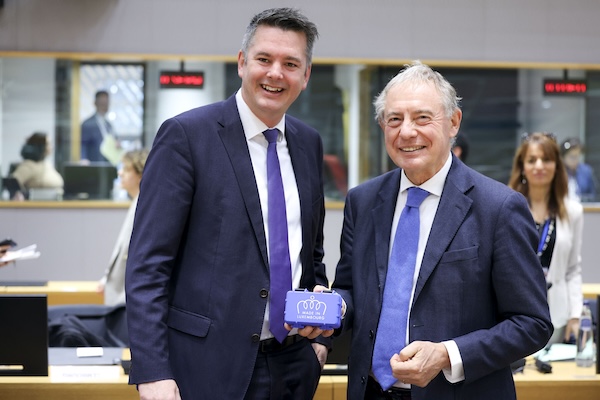
 (L-R) Lex Delles, Luxembourg's Minister of the Economy, SMEs, Energy and Tourism; Adolfo Urso, Italian Minister for Enterprises;
Credit: ©European Union
(L-R) Lex Delles, Luxembourg's Minister of the Economy, SMEs, Energy and Tourism; Adolfo Urso, Italian Minister for Enterprises;
Credit: ©European Union
On Wednesday 25 February 2026, Luxembourg’s Minister of the Economy, SMEs, Energy and Tourism, Lex Delles, attended the European Union’s Competitiveness Council meeting in Brussels, dedicated to the internal market and industrial policy.
It was the first session held under the Cypriot Presidency of Michael Damianos, Minister of Energy, Commerce and Industry.
According to Luxembourg’s Ministry of the Economy, the Council opened with a debate on the untapped potential of the internal market, following the publication of the European Commission’s 2026 Annual Single Market and Competitiveness Report. The report highlighted a European economic environment facing significant geopolitical and trade pressures, including industrial overcapacity in third countries, increased export controls and the instrumentalisation of economic dependencies. In this context, ministers stressed the need to address the “Terrible Ten”, the ten most harmful obstacles identified in the Single Market Strategy, including disproportionate service requirements, excessive authorisation procedures and territorial supply restrictions (TSR), which affect all Member States, particularly Luxembourg, and are to be treated as a priority.
In his intervention, Minister Delles stated: “The European Union too often remains a collection of 27 mini national markets rather than one large single market. Yet its potential is immense: removing barriers to trade in goods and better integrating services could generate several additional percentage points of growth.” He added: “We must complete the construction of a genuine single domestic market for all our companies. This requires measurable objectives, a clear roadmap, simple common rules based on harmonisation and mutual recognition – one in, 27 out – and rigorous enforcement of existing legislation. Luxembourg stands ready to engage fully, including at national level, to remove these obstacles constructively.”
The second debate of the morning focused on the follow-up to industrial action plans under the Clean Industrial Deal for the European steel, automotive and chemical sectors. Minister Delles welcomed these action plans, which he said were moving in the right direction in response to the worrying erosion of Europe’s strategic industrial base. However, he stressed the urgency of acting swiftly to avoid creating excessive complexity for businesses in terms of procedures, costs and legal requirements.
To prevent carbon leakage in the steel sector, he emphasised the need to broaden the scope of the Carbon Border Adjustment Mechanism to include more downstream products in value chains essential for clean technologies, mobility and defence, the ministry noted. Regarding the Industrial Accelerator Act, he stated: “Europe must strengthen its strategic autonomy while maintaining open markets. ‘European preference’ should mean that Europe supports its industrial champions in key sectors while remaining connected to global trade. Rather than promoting ‘Made in Europe’, we should promote ‘Made with Europe’ in order to preserve our role in international value chains and develop a strong, sustainable and innovative industry.”
During lunch, ministers exchanged views on the future “one Europe, one Market” roadmap announced by European Commission President Ursula von der Leyen following the retreat of EU leaders at the beginning of February, the ministry added.
In the afternoon, the Council approved the conclusions of the Consumer Agenda 2030 and discussed the role of SMEs in the future European Competitiveness Fund (ECF), which is intended to replace fourteen existing programmes in order to create a unified investment capacity and foster a genuine European capital market. The fund aims to strengthen the Union’s competitiveness in strategic technologies and sectors, reduce strategic dependencies and stimulate private investment. It is set to have a budget of €234.3 billion for the period 2028-2034.
Another item on the agenda was the European strategy for the bioeconomy.
The strengthening of Europe’s industrial base had already been discussed the previous evening during an informal dinner of the “Friends of Industry”, attended by Minister Delles. The meeting followed discussions launched in Berlin on 3 November 2025 among Member States advocating an ambitious and coherent European industrial policy. During the dinner, which brought together representatives from nineteen EU Member States, ministers acknowledged the growing deindustrialisation in Europe and stressed the need to strike a fair balance between regulatory requirements and competitiveness. They underlined the importance of clear and predictable frameworks without unnecessary bureaucratic obstacles and called on the European Commission to conduct a comprehensive review of EU legislation to assess regulatory coherence and implement the necessary simplifications.