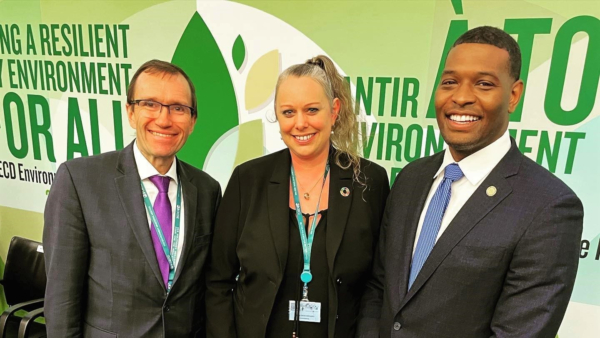
 (L-R) (L-R) Espen Barth Eide, President of the UN Environment Assembly (UNEA); Carole Dieschbourg, Minister of the Environment, Climate and Sustainable Development; Michael S. Regan, US EPA;
Credit: MECDD
(L-R) (L-R) Espen Barth Eide, President of the UN Environment Assembly (UNEA); Carole Dieschbourg, Minister of the Environment, Climate and Sustainable Development; Michael S. Regan, US EPA;
Credit: MECDD
On Thursday 31 March 2022, ministers and national representatives of the 38 Organisation for Economic Co-operation and Development (OECD) member countries and the European Union, as well as Bulgaria, Croatia, Peru and Romania, adopted an official OECD declaration in which they commit to stepping up their climate and environmental activities.
Countries pledged to do more to halt biodiversity loss, tackle plastic pollution, align finance with environmental goals and accelerate action on climate change so that limiting global warming to 1.5°C remains within reach.
The Ministerial Declaration was adopted at the close of the OECD Environment Ministerial Meeting, chaired by Luxembourg's Minister of Environment, Climate and Sustainable Development, Carole Dieschbourg, and united States administrator of the Environmental Protection Agency (EPA), Michael S. Regan, which took place on 30 and 31 March 2022, and at which assisted the ministers responsible for the environment of OECD countries, the European Union and several non-member countries (Argentina, Brazil, Bulgaria, Croatia, Egypt, Indonesia, Kazakhstan, Peru and Romania), as well as representatives of international organisations.
Flagship Commitments of the Declaration
- Develop and implement effective and ambitious environmental and climate strategies with the aim of achieving greenhouse gas neutrality by 2050, including by accelerating action during this crucial decade so that the objective of containing the rise in the planet's temperature to 1.5°C remains within our reach.
- Redouble efforts to align post-COVID-19 recovery plans with environmental and climate goals, to deliver a green, inclusive and resilient recovery for all.
- Develop comprehensive and coherent approaches based on the circular economy to combat plastic pollution and promote enhanced engagement in the framework of the intergovernmental negotiating committee responsible for developing an international legally binding instrument to combat plastic pollution, with the ambition to conclude these negotiations by the end of 2024.
The move mirrors the findings of the OECD's recently published Global Plastics Outlook, which shows that global plastic waste production more than doubled between 2000 and 2019 to 353 million tonnes.