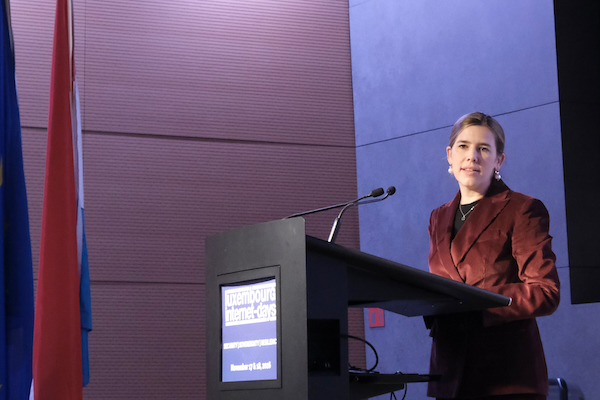
 Elisabeth Margue, Luxembourg Minister Delegate to the Prime Minister responsible for Media and Connectivity;
Credit: Steven Miller, Chronicle.lu
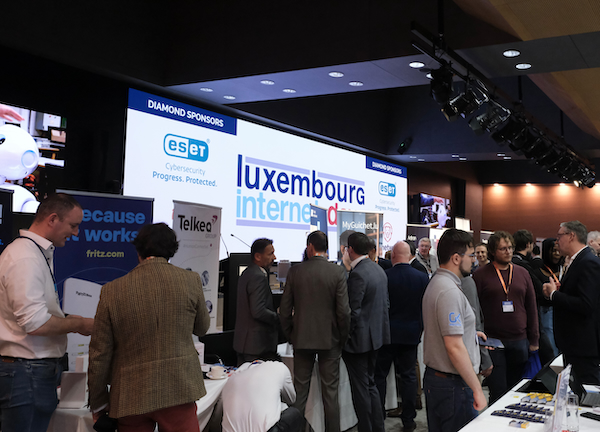
On Tuesday 17 November 2026, Luxembourg Internet Days opened at the Luxembourg Chamber of Commerce in Luxembourg-Kirchberg, with ICT professionals, CTOs, CIOs and IT decision makers gathering to discuss internet-related challenges, network and Cloud security and sovereignty threats.
For the 2026 edition, the two-day conference features a series of focused conferences, interactive panel discussions and workshops, under the theme “Security, Sovereignty & Resilience”. Additionally, a 47-booth expo allows the expected 1,300 attendees to meet with a variety of developers and providers offering ICT services in Luxembourg and beyond.
Following an opening panel discussion on cyberthreats and the interdependency of ICT systems, the event’s opening address was given by Claude Demuth, Chairman at LU-CIX asbl, in which he asked who controls our data, our networks and communications tools, highlighting how these elements ultimately control our lives.
Placing an emphasis on the importance of close collaboration between public and private sectors, particularly in a small country such as Luxembourg, Claude Demuth detailed that the relationship between LU-CIX - the non-profit association whose mission is to develop and support Luxembourg's Internet infrastructure and ICT ecosystem - and Luxembourg Internet Days can “build those bridges and make the internet in Luxembourg a more reliable and safer place for all of us”.
Claude Demuth revealed that for the first time, the event would dedicate a full session to Luxembourg’s healthcare sector, and stressed that “security, sovereignty and resilience matter just as much for hospitals and care facilities”. Additionally, he announced that for the 2027 edition, a full day will be dedicated to the healthcare sector.
Marc Hostert, Government Advisor at the Luxembourg Ministry of Health and Social Security, the gave a speech in which he thanked the organisers for placing a new emphasis on ICT security in healthcare, noting that this was “a topic that will concern and challenge us over the next ten years as we seek to support the healthcare sector”.
After detailing the governmnet's investment made in the digitalisation of the healthcare sector, he noted the “solid foundations” of its digital services but emphasised that “we have entered a new phase, a new stage in which the objective is no longer simply to digitise processes but to build a genuine digital healthcare ecosystem serving patients, healthcare professionals and the healthcare system as a whole”.
Marc Hostert explained that over the coming decade, Luxembourg will implement the European Health Data Space (EHDS) - a framework designed to make health data easier to access, share and re-use securely across all EU Member States - and said: “This approach is not simply about introducing technologies or bringing data together. It should serve patients, stakeholders including healthcare professionals, research and also the Luxembourg economy as part of its broader policy objectives. The aim is to facilitate the exchange of information between patients, healthcare professionals and institutions, thereby making the healthcare system more efficient and more personalised.”
He encouraged stakeholders in Luxembourg's healthcare ecosystem, as well as those operating across borders and at European level, to “actively prepare for this new reality” and invited software providers, consultants, technicians and engineers to contribute to the future development of this emerging sector.
“Today, we have an opportunity to participate in building a new digital healthcare environment: one that is more connected, more patient-centred, where data serves humanity and digital technology strengthens the quality of care,” said Marc Hostert.
During his speech, Carlo Thelen, Director General of the Luxembourg Chamber of Commerce, highlighted that security, sovereignty and resilience are becoming increasingly critical to the country’s economy and is ever more dependent on digital technologies.
“Today, almost every part of a business relies on digital tools, from payments and logistics to customer relations and production. As more critical functions depend on them, the infrastructure behind these tools is becoming essential for businesses to run. And AI is perhaps the clearest example,” he remarked.
Detailing that around one in three Luxembourg businesses uses AI in 2025, compared to one in five across the EU, Carlo Thelen asked: “Using AI is only one thing. Getting real value from it is another. The real question is, does AI make us more productive?”
“We need to turn this growing use of AI into real productivity gains and delivering that value requires the right infrastructure. So putting AI to work requires more than algorithms. It requires data, computing, power, secure infrastructure and energy. And as AI is used more widely, the demand for infrastructure is growing.”
Carlo Thelen highlighted that Europe relies on other countries for more than 80% of its digital products, services, infrastructure and intellectual property, creating a level of dependence which creates risk. He stressed that reducing these dependencies and strengthening Europe's own capabilities is now a priority.
“Luxembourg is well positioned to address this challenge but having expertise is not enough. We need to turn it into resilience for businesses, protecting their operations, their continuity, and their competitiveness… There are strong foundations, but foundations only matter if we build on them. The challenge now is to move from experiments to business applications, from pilots to scale, and from technology to business value. And this is where Luxembourg needs to rediscover one of its traditional strengths, pragmatism,” he said.
“The message is simple. Luxembourg needs to turn its digital assets into real business value and competitive advantage. That means making sure our business can adopt new technologies productively, that we have infrastructure and skills to support them, and that we remain secure and resilient. It also means staying open to innovation while strengthening our digital survival. Technology is moving fast, and Luxembourg must keep up.”
Following Carlo Thelen, Elisabeth Margue, Luxembourg’s Minister Delegate to the Prime Minister responsible for Media and Connectivity, spoke of the importance of Luxembourg’s internet infrastructure and the crucial role it plays in the country’s digital economy. She noted that in the three years she has been attending the conference, the threats to this infrastructure have evolved greatly: “What is different is that today attacks come from artificial intelligence agents, sometimes coordinated in very large numbers. They change from one system to another in machine speeds. And from an exchange point, this means management, technical teams, but also equipment facing constant pressure. The time gap between the discovery of the vulnerability and the expectation is becoming smaller.”
The minister emphasised that defensive automation and preparation for rapid response are key and that with the proposed regulation on digital networks risk management (NIS2), supporting and governing these issues becomes a legal obligation and called upon all relevant parties to make this standard practice, as well as respecting the upcoming Cloud and AI development package (CADA) - the proposed European Union regulation designed to strengthen Europe's cloud computing and artificial intelligence infrastructure, competitiveness and technological sovereignty.
“I believe that it is important to make sure that not only businesses follow the evolution of digitalisation and artificial intelligence but also citizens should be well-prepared in that evolution… [They] face threats: phishing, fraud, dark patterns and also defects, and we should give the customers what they need to make sure that they are in a position to defend themselves by securing their passwords, by protecting their data, and protecting their devices, providing the necessary assistance,” said Minister Margue.