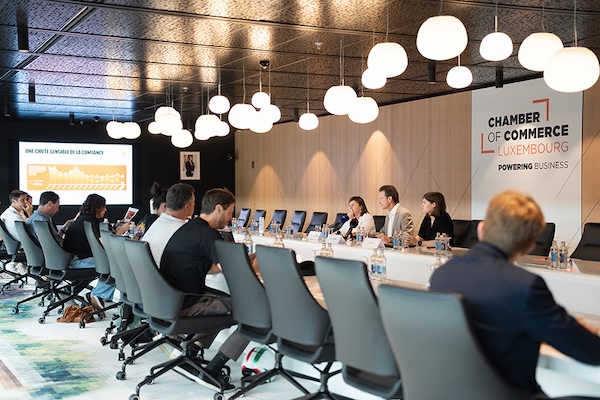
 Credit: © Matthieu Freund-Priacel, Primatt Photography
On Tuesday 30 June 2026, the Luxembourg Chamber of Commerce presented the results of the fifteenth edition of its Economy Barometer for the first half of 2026, highlighting a sharp decline in confidence in the national economy amid geopolitical uncertainty and rising production costs.
According to the Chamber of Commerce, the survey, conducted between 13 April and 5 May 2026 among 621 Luxembourg companies, saw the overall Economy Barometer score fall to 49.4 points, down from the previous edition and returning to historically low levels.
The Chamber noted that although 73% of companies remained confident about their own future, confidence in Luxembourg's economy had fallen by 30 points compared with the pre-COVID period, reaching its lowest level since the Economy Barometer was launched in 2019.
The survey found that business activity had been affected by an unstable and volatile economic environment. While 17% of companies had expected activity to decline over the previous six months, nearly twice as many ultimately reported lower activity during the first half of 2026. Expectations for the second half of the year remained weak, reflecting limited visibility and continued caution among business leaders.
Profitability also remained under pressure due to rising production costs. Thirty-six percent of companies recorded lower profitability during the previous six months, while 27% expected profitability to deteriorate further during the next six months.
The economic slowdown also affected investment and employee training. One in five companies reported reducing investment over the previous six months and the same proportion expected to reduce investment during the next six months. Meanwhile, only 56% of companies had launched or continued employee training programmes during the past year, the lowest level recorded by the Economy Barometer since 2020.
One positive trend emerged regarding investment priorities. The share of companies planning intangible investments related to artificial intelligence (AI) for 2026 and 2027 doubled compared with the previous year.
"It is this capacity for transformation, even in a context of multiple crises, that will be decisive in preserving competitiveness over the long term," said Christel Chatelain, Director of Economic Affairs at the Luxembourg Chamber of Commerce.
Only 2% of respondents said administrative procedures had become simpler during the previous twelve months, the lowest level recorded since the Economy Barometer was introduced.
"Our Barometer reflects a gloomy first half of the year, even though 2026 was announced as the year of competitiveness. While the measures decided during the tripartite meeting are emergency, short-term measures, it is now essential to strengthen, in a sustainable way, the conditions that allow companies to remain competitive. This requires structural reforms, effective administrative simplification and appropriate conditions enabling businesses to invest, innovate and attract talent over the long term," said Carlo Thelen, Director General of the Luxembourg Chamber of Commerce.
The thematic section of the survey focused on recruitment and staff retention. During the past two years, 91% of companies had recruited employees, with 90% of those reporting recruitment difficulties. Nearly half cited a mismatch of skills as the main obstacle, alongside unrealistic salary expectations and insufficient qualifications.
Recruitment challenges were particularly significant for candidates with up to eight years of professional experience, with 87% of companies reporting difficulties hiring these profiles. As a result, 65% of respondents said existing employees had experienced increased workloads.
At the same time, 80% of companies had introduced or planned measures to attract and retain employees, including flexible working hours, improved working conditions and career development opportunities. Nevertheless, 35% of respondents reported an increase in voluntary staff departures over the past five years, making employee retention an increasingly important strategic priority. The Chamber added that these challenges were slightly more pronounced for Luxembourg residents than for cross-border workers.