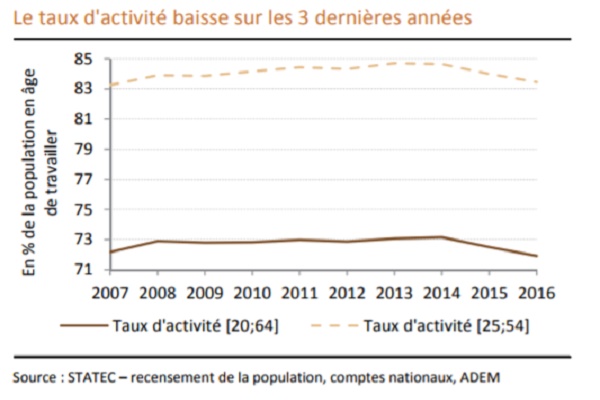
 Activity rates over past 3 years;
Credit: Statec
Activity rates over past 3 years;
Credit: Statec
The economic downturn in 2008-09 has led to an increase in unemployment, but also underemployment in Luxembourg, according to Statec.
Following the economic crisis, the flagship indicators of the labour market- job creation and unemployment rate- have deteriorated significantly. Over this period, other indicators also reveal an increase in underemployment. These indicators include the underutilisation of the work factor, turnover rate, real wages, subsidised jobs, partial unemployment, working time and activity rate.
The underutilisation rate of the labour factor, ie the ratio of the total population that would like to work or work more and the workforce, has increased in Luxembourg by 9% in recent years, from 6% in 2008 to 15% in 2015. This increase is greater than that of the unemployment rate, which, following the financial crisis, only increased by 3% from 4% of the active population in 2008 to 7% in 2014.
Meanwhile, 114,130 people were recruited in 2016, in contrast to 94,300 contract terminations. This is an 8.6% year-on-year increase in labour flows, after +5.5% in 2015 and +5.6% in 2014. The turnover rate increased in 2016 for the third year in a row. With 27.5%, it reached its highest level since the beginning of the financial crisis.
Another indicator was working time, ie the number of hours worked by an individual. This has experienced a structural decrease of 0.2% over the last twenty years, a phenomenon that
can be explained mainly by the rise in female employment and part-time work associated with it.
Moreover, wages declined in 200, 2011 and 2012- only growing again in 2016- whilst underemployment increased in 2012 and 2013 despite a steady rise in employment. Concerning partial unemployment, in 2009, the number of people who worked on a reduced basis decreased from 3.2% in 2009 to 0.2% in 2016.
While the financial crisis started in 2008, the year 2012 marked the culmination of the crisis on the labour market, at least on the basis of the underemployment indicators analyzed here.
For the years 2016 and 2017 the indicators display a decline in underemployment and therefore an improvement in the labour market.