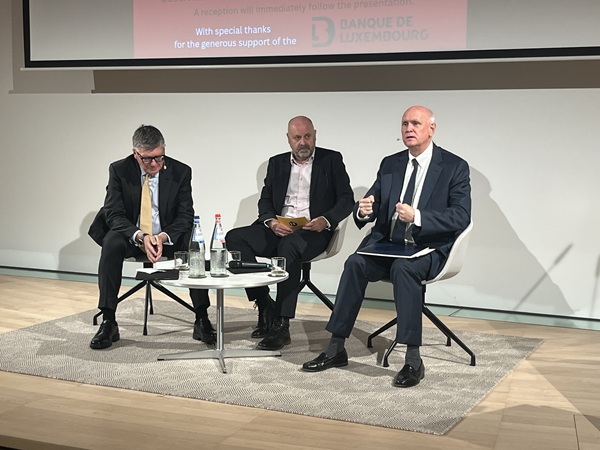
 (L-R): Robert Schaus, Dunc Roberts, Jim Townsend;
Credit: Chronicle.lu
On Monday 16 November 2026, the Miami University Luxembourg Foundation (MULF) held an event at the Banque de Luxembourg in Luxembourg city centre on the topic of "The New Transatlantic Relationship: Will it Work?".
Around 90 people attended the event which had Jim Townsend, former US Deputy Assistant Secretary of Defence for European and NATO Policy, was keynote speaker.
Luc Rodesch, Member of the Executive Committee at the Banque de Luxembourg, welcomed those attending and introduced the private bank which he said is committed to Luxembourg’s intellectual and cultural life. He said that the relationship between Luxembourg and the United States is extremely important.
Janet Steinmetzer, Member of the Board of Directors of MULF, introduced the foundation’s series of events and thanked the guest speaker for taking time out of his busy schedule to address the MULF’s event. She said that MULF is committed to global education, including interaction with other cultures. She revealed that they shortly hope to announce a new scholarship for two Luxembourg students to attend the Miami University in the US.
Dunc Roberts, moderator, talked about his 30 years of political reporting in Luxembourg, during which time he interviewed ten US ambassadors, each of whom stressed the importance of US - Luxembourg relations.
Jim Townsend said he and his wife have learned a lot of Luxembourg’s history and mentioned going to the American Military Cemetery in Merl. He talked about the “thrilling time” in the early 1990s after the fall of the Berlin Wall. He said he would talk about the changes in the Transatlantic relationship as well as the impact or the recent midterm elections.
He talked about NATO expanding, the EU growing and other significant events since 1949. Part of the 1990s was an understanding was that the US would stay in NATO and continue to support Europe, still “calling the shots”. Defence spending dropped and European armies got smaller, and the US military presence and defence spending would reduce too.
Under George W Bush, US defence changed and when 9/11 happened, things changed. He talked about NATO’s Article 5 as the US wanted to “dictate Afghanistan”. NATO invoked Article 5 and ended up being central to the mission in Afghanistan.
Other things happened too, including Abu Ghraib and torture allegations, which allies saw and feared that they did not share the same values as the US, meaning changes to the Transatlantic alliance.
At that time too was the rise of Putin in Russia - he came to power in 1999. Instead of Russia being considered as NATO equals, they discouraged NATO growth. In 2008, in Bucharest, there was a proposal (drafted by Britain) that Ukraine and Georgia would become NATO members, to which Russia did not agree.
Under Obama, after Russia had entered Georgia, they felt that “Russia was on the march”. They also felt that a lot of military strength should address China. Then Trump was elected, seeing policies being made based on grievances, “it was time for payback”. Under Biden, there was a bit of a return to normality; but then Trump II came in, with the beginning of stepping away from NATO.
He referenced the issue of Greenland which “tore the fabric” of the Transatlantic alliance; he also mentioned deteriorating regarding Canada. Trump felt that Europe’s position regarding Iran was “treasonous”.
He said that NATO is going to be unrecognisable, with more European leadership. The new transatlantic relationship will be different. He sees more European, and less American, involvement, particularly regarding Russia, including a race to put in place solutions to deter the Russians.
Robert Schaus, Vice President at LuxDefence, responded with some remarks and talked about Luxembourg historically not being actively in defence, with the last arms manufacturing in Diekirch in the 1950s. Recommendations have addressed infrastructure being set up to help industry as well as the way procurement is organised, including offsets.
He also mentioned the Luxembourg army being involved in testing new equipment, and that many companies are now becoming involved in defence, including producing night vision equipment, vehicle parts, etc. Another aspect he mentioned was the investment in the defence sector.
Jim Townsend and Robert Schaus then had a brief discussion / conversation, moderated by Duncan Roberts. Jim Townsend described the midterm election results as a rejection of Trump’s policies, and mentioned that there will be short-term and long-term changes, stressing that the democratic system works. He stated that the President has a lot of power, but the houses have “the power of the purse” and oversight. He also said that the Senate must approve new appointments. He expects a lit of gridlock and vetoes. He also expects “civil wars” internally between Republicans, as well as internally within Democrats.
Looking ahead to the next Presidential election, he said that even if there is a Democrat win, it will not be a return to the same, but it will be the younger generation making changes, and Europe will have more power in Transatlantic matters.
He stressed the importance to deter Russia now, when technologies are evolving so quickly.
On the midterms, Robert Schaus said that he does not expect much change in the next two to four years, but he feels that Europe will be stronger, in relation to Ukraine, Moldova, etc.
He mentioned that next year Ukraine plans to use 2-3 million drones, which is a staggering amount. But decision-making systems, to allocate budgets, etc., are outdated.
Jim Townsend said there is a specialised skills shortage in the US, with just one shipyard able to make specific submarines, etc. New approaches are needed, and he said that Ukraine can teach us a lot.
He also stressed Luxembourg’s strategic importance in satellite technology which he described as a “quiet strength”. He also talked up Europe’s ability to get around the table and work out solutions.
The speakers agreed that while in the past we may have had 25 years to do something, we really just have two years now…
There was then a Q&A with members of the audience, moderated by Duncan Roberts. In response to a question from Chronicle.lu “You were talking about Luxembourg’s strengths in satellite technology. What is your take on the restrictions imposed on Ukraine on the used of Starlink, and can Luxembourg possibly help in this area?”, Jim Townsend responded that the power that the large technology companies have is wrong and is a threat to national security.
The formal part of the evening was followed by a reception.
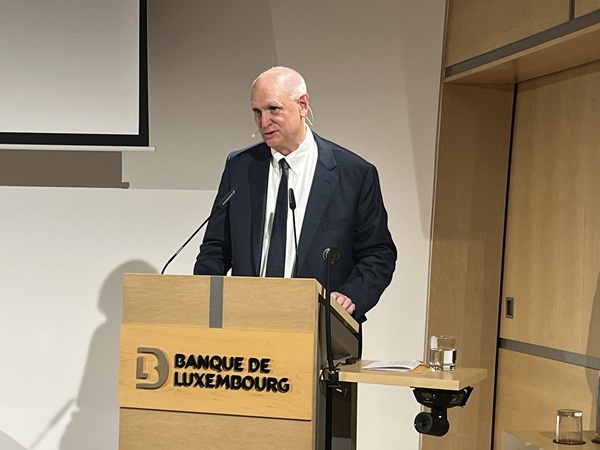
Photo: Jim Townsend, credit: Chronicle.lu