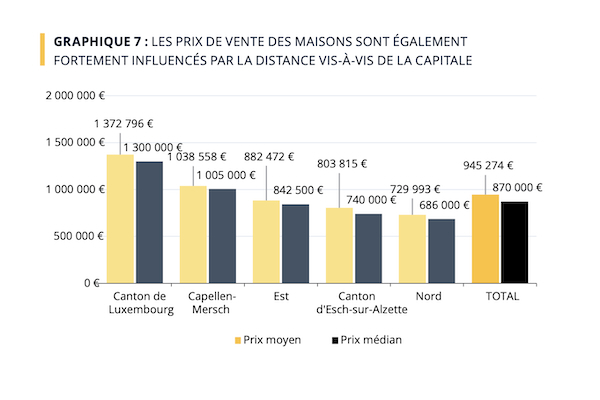
 House selling prices are strongly influenced by the distance from the capital;
Credit: Source: STATEC
House selling prices are strongly influenced by the distance from the capital;
Credit: Source: STATEC
On Thursday 24 September 2026, Luxembourg's Housing Observatory (Observatoire de l'habitat) published the 20th edition of its report on the residential property market, presenting an overview of developments in residential property transactions, sale prices and advertised rents during the second quarter (Q2) of 2026.
A gradual normalisation of real estate activity following the exceptional peak in 2025
In the second quarter of 2026, the residential property market continued to normalise following the exceptional level of activity recorded one year earlier, particularly as a result of the anticipation of the end of several temporary tax measures on 30 June 2025. A total of 1,274 apartments were sold in the second quarter of 2026, an increase of 8.2% compared with the previous quarter, but a decrease of 33.9% year-on-year. The existing-apartment market now appears to be close to the levels observed before the crisis, with 1,049 sales. By contrast, the market for apartments under construction remains particularly subdued, with only 225 sales, almost 68% fewer than the average for the second quarters of 2017 to 2021. The house market also remains below pre-crisis levels, with 709 transactions in the second quarter of 2026, compared with an average of 909 transactions in the second quarter between 2017 and 2021.
Prices broadly stable, with contrasting developments across segments
In the second quarter of 2026, the general house price index fell by 2.2% year-on-year but increased by 1.1% compared with the previous quarter. The annual decline is largely explained by a base effect linked to the exceptional level of prices and activity in the second quarter of 2025. Developments nevertheless remain varied across segments: prices for existing apartments fell by 0.6% year-on-year, while those for existing houses decreased by 3.7% and those for apartments under construction by 2.5%.
Significant differences depending on location and housing characteristics
According to the Housing Observatory, location remains a key factor in sale prices. For apartments, prices per square metre generally decrease with distance from Luxembourg City and also tend to be higher for smaller properties. Apartments under construction remain on average 23% to 29% more expensive per square metre than existing apartments of comparable size. For existing houses, the average price is approximately €1.37 million in the canton of Luxembourg, compared with around 88% less in the north of the country. These differences illustrate the continuing importance of location and housing characteristics in determining prices on the Luxembourg residential property market.
Focus on… recent developments in asking rents
In the second quarter of 2026, asking rents for apartments increased by 5.8% year-on-year and by 0.6% compared with the previous quarter. This increase is significantly higher than overall inflation, which stood at 2.4% over the same period. Following a period of relative stabilisation in 2024 and early 2025, asking rents have therefore accelerated again.
The Housing Observatory highlighted that these indicators, calculated on the basis of property advertisements collected by the Housing Observatory in collaboration with the Immotop.lu property portal, measure the rents requested for new rental contracts. They therefore do not measure the rents actually paid by all tenants. Rents under existing leases are increasing much more moderately: according to STATEC statistics, the index of rents under existing leases increased by 1.3% year-on-year in the second quarter of 2026.
Furnished rooms are also accounting for an increasing share of the rental supply: they now represent around 14% of advertisements, compared with less than 3% at the beginning of the 2010s. Between 2010 and 2025, their asking rents increased by 102.6%, compared with 83.0% for apartments and 76.9% for houses. In the second quarter of 2026, they increased by a further 4.9% year-on-year.
Focus on… a regional house price index
The 20th edition of the report now presents new regional house price indices to provide a better picture of regional differences in the Luxembourg property market.
For existing apartments, long-term developments are relatively similar between the capital region — comprising Luxembourg City, Hesperange, Bertrange, Strassen and Walferdange — and the rest of the country. Between the first quarter of 2015 and the second quarter of 2026, the index increased by 73.5% nationally, by 70.8% in the Luxembourg region and by 73.7% in the rest of the country.
The differences are more pronounced, however, for apartments sold off-plan (VEFA). Over the same period, their index increased by 113.2% in the Luxembourg region, compared with 74.2% in the rest of the country.
These results should nevertheless be interpreted with caution, particularly because of the low number of transactions in the new-build market since 2023, which has resulted in greater volatility in the regional indices.
An adapted house price index methodology to better account for accessibility
The Housing Observatory announced that the methodology used to calculate the hedonic house price index has been adapted: travel time to Luxembourg City now replaces distance from the capital as the location variable. This change makes it possible to take better account of the accessibility of properties to the capital.
Its effect on the overall index remains limited: in the second quarter of 2026, annual price growth would be -1.6% under the new methodology, compared with -2.2% under the previous methodology. The impact is more pronounced for certain segments, particularly apartments under construction. This adaptation is intended to better neutralise differences in location between properties sold from one period to another and thereby measure “pure” price developments more accurately.
The Housing Observatory's statistics have also been updated on logement.lu, the National Geoportal and data.public.lu.
The full report can be found at https://statistiques.public.lu/en/publications/series/logement-chiffres/2026/logement-02-26.html.