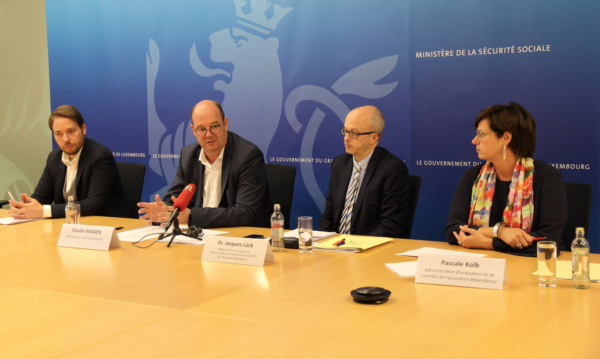
 (L-R) Tommy Klein, TNS ILRES, Claude Haagen, Minister for Social Security, Dr Jacques Lück, Deputy Director General of the AEC, Pascale Kolb, Head of Partnership and Information at the AEC;
Credit: MSS
(L-R) Tommy Klein, TNS ILRES, Claude Haagen, Minister for Social Security, Dr Jacques Lück, Deputy Director General of the AEC, Pascale Kolb, Head of Partnership and Information at the AEC;
Credit: MSS
During a press conference on Thursday 9 June 2022, Luxembourg's Minister of Social Security, Claude Haagen, and the Administration for the Evaluation and Control of Dependency Insurance (l'Administration d'évaluation et de contrôle de l'assurance dépendance - AEC) presented the results of a survey of satisfaction achieved with long-term care insurance beneficiaries living at home and their caregivers.
Following the long-term care insurance reform that came into force on 1 January 2018, as well as demographic, technological and societal changes, the AEC and the Ministry of Social Security wanted to carry out new satisfaction surveys among beneficiaries of long-term care insurance, particularly those living at home.
Currently, around 8,800 beneficiaries live at home, which represents two-thirds of long-term care insurance beneficiaries. Of these, 72% benefit from the support of a carer (11% exclusively and 61% in combination with a support and care network).
The introduction of long-term care insurance in 1999 aimed to promote and develop home support. As part of the long-term care insurance reform in 2018, the guiding principle of “home care” was reinforced by various services, in particular “home care activities”.
The objectives of the satisfaction survey - part specifically dedicated to the carer
The survey carried out therefore focused on the following three main objectives:
- satisfaction with the functioning of the long-term care insurance assessment and control administration (AEC): the visibility, availability and communication of its employees, follow-up of the file, deadlines and information received;
- the choices in the organisation of home care, the impact of the different types of services granted and the relative satisfaction, the distribution of aid and care and the limits for maintaining home care;
- knowledge and consumption by the carer of the services that are linked to his respite and the feeling of the carer as a person actively participating in the care.
A better understanding of the carer's needs makes it possible to better target the available measures, or even to cover the needs with additional measures. The caregiver plays a key role in keeping the beneficiaries at home.
The survey was entrusted to TNS Ilres and participation was voluntary. 295 beneficiaries living at home as well as 194 caregivers were interviewed between May and December 2021 through face-to-face interviews at their homes.
Results of the survey and areas for improvement
Overall, there is great general satisfaction with the functioning of the AEC: 88% of beneficiaries are satisfied with the services provided by the AEC, including 55% who are very satisfied.
Policyholders also express their satisfaction with contacts with the AEC, reached by telephone, the preferred means of contact. In 2021, the “helplines” made it possible to respond to more than 11,000 calls from policyholders. The extension of the ranges of the “technical aids” helpline has considerably improved telephone reception through more direct access to the competent department (halving of the number of abandoned calls).
One point for improvement is undoubtedly the information provided to policyholders by further exploring the main vectors of information for claimants about long-term care insurance, namely treating physicians and hospital social services.
With regard to the organisation of care around the dependent person, it should be noted that 93% of the beneficiaries are satisfied with the services of the long-term care insurance compared to the possibility of home care, including 68% who are very satisfied.
71% of the beneficiaries questioned the underlying importance of the help of their carer in the essential acts of life respectively, 62% in the activities of assistance with the maintenance of the household in their stay at home and 63% cite the importance of the free availability of technical aids to enable them to ensure home support.
This satisfaction goes hand in hand with the deep feeling and desire of policyholders to stay at home as long as possible, despite their loss of autonomy. Long-term care insurance therefore provides the right answer to this vulnerable population and these statements only confirm the success story that long-term care insurance has been in Luxembourg since its introduction in 1999.
For 88% of caregivers, it is "normal" to help, 79% have a strong emotional bond with the dependent person and 71% believe that, thanks to their help, the dependent person can stay at home instead of going to establishment. 90% of carers interviewed intervene every day and 88% even several times a day with the dependent person. The interventions concern both aid for the essential acts of life (91%), but also, more generally, for the tasks of daily living (97%) such as preparing meals, preparing and administration of medication, shopping or laundry. 81% indicate that they also offer moral support to the dependent person. 33% intervene at least once a week during the night, including 16% every night. The intensity of these tasks certainly has repercussions on the life of the carer and affects their physical and mental health, their family, social and personal life. 70% of those surveyed believe that personal health problems constitute a limit to keeping the dependent person at home. However, it should be noted that the vast majority of carers express their satisfaction with long-term care insurance benefits as support in their role as carers. 84% manage to find moments of respite.
Conclusions and planned actions
Since the 2018 reform, a set of measures have been adjusted, or even created, to further support the caregiver in supporting the dependent person, including caregiver training and night care.
However, caregivers do not always use existing measures and needs are also changing. This is why communication will be strengthened and better targeted, in particular by using the various existing communication channels, to better inform caregivers of the measures for their destiny. In this context, telephone reception (11,000 calls were handled in 2021) was already reinforced at the beginning of the year by extending the access ranges.
In the medium term, reflections will focus on expanding existing measures and also on the need to create additional measures to better support caregivers in the performance of their tasks, but also to relieve them. It is more concretely a question of analysing an extension of carers who can benefit from the training already covered (six hours per year), of reviewing the possible services during the night (night guards, etc.), of analysing an adjustment of the amounts of cash benefits and also to analyse experiences abroad in terms of reconciling professional life/ carer's activities (special “carer” leave, etc.).
These measures will be the subject of in-depth analyses to be discussed with the social partners with a view to the necessary legislative adaptations.