 Credit: ECPAT Luxembourg
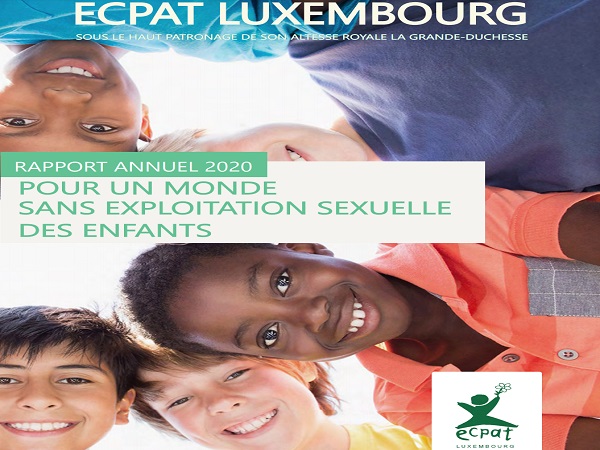
ECPAT Luxembourg, a local non-governmental development organisation whose mission is to fight against the sexual exploitation of children, has published its activity report for the year 2020.
Last year, ECPAT Luxembourg observed two parallel phenomena: the COVID-19 pandemic which increased vulnerabilities and more openness when talking about sexual violence.
Effects of the pandemic
The pandemic has increased the precariousness of the most vulnerable all over the world. The multiple lockdowns have brought down a whole section of the survival economies, throwing the most vulnerable populations, mainly women and children, into even greater poverty. In terms of health, the difficulties of health systems in coping with the pandemic first impacted the poorest. On the social level, this pandemic has increased violence, particularly within the family.
The non-profit's work in the prevention, protection and rehabilitation of children has been all the more crucial during this period. For instance, strict confinements hindered initiatives such as taking young women out of prostitution and helping them find economic activity, for example opening a shop in Nepal. Instead, ECPAT Luxembourg had to economically support these young women so that they do not return to a situation of sexual exploitation for lack of an alternative.
These situations have multiplied in the Asian countries where the non-profit works, namely in India, Nepal and Cambodia, which have been severely affected by the pandemic. ECPAT luxembourg thus had to unblock humanitarian aid activities to deal with these unprecedented situations.
Breaking taboo around sexual violence
According to the 2020 activity report, the second striking phenomenon of 2020 is the fact that there is relatively more talk about sexual violence and exploitation. The pandemic is considered a catalyst as the media reported the increase in violence linked to the situation. ECPAT Luxembourg deemed this a very positive movement because it is giving visibility and breaking the taboo surrounding this violence. There has also been greater recognition of the victim in their right to talk about and report the crime, in their right to reparation and in their right to rehabilitation.
In addition, sexual violence has now become a cross-cutting subject that can be found on the political agendas of many countries and in particular in Luxembourg.
The non-profit noted that its awareness-raising work is crucial here and participates in this movement, for example through awareness campaigns for the general public as well as the advocacy work it does with the authorities of the countries in which it works, including in Luxembourg with the development of a shadow report on child protection for the United Nations (UN).
This context of awareness of the importance of protecting potential victims of violence is also conducive to the establishment of procedures and measures to protect children. Thus, last October, ECPAT Luxembourg launched a national project in Nepal, with the Nepalese government, aimed at ensuring that all structures receiving children are strengthened and have protection procedures. The non-profit is doing similar work in Luxembourg, currently with sports structures.
Impact of new technologies
In its report, ECPAT Luxembourg also noted that its work in the fight against this scourge of sexual violence is all the more important in light of new technologies, such as internet access, which allow new forms of violence. The non-profit is raising awareness among young people in Luxembourg and beyond about grooming and sexting.
ECPAT Luxembourg concluded that its work forms part of a social movement: we are all responsible for the children around us. And so, everyone can have a role to play, by taking responsibility for the protection of children, whether in their family and social environment, whether at home while surfing the internet or abroad when travelling.
The non-profit has also set up a website for reporting violence against children: www.childprotection.lu.
The full activity report for 2020 (in French) can be downloaded from ecpat.lu/actualite/rapac-2020/.