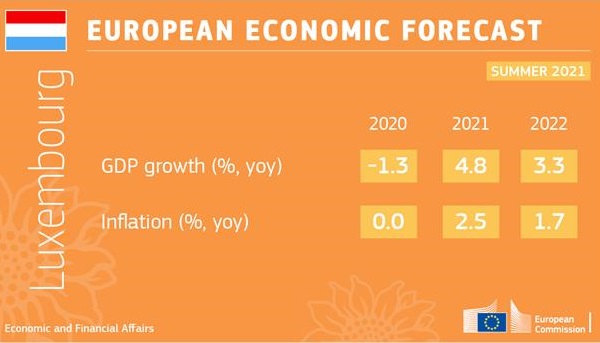
In its "Summer 2021 Economic Forecast", the European Commission has reported that the European economy is forecast to rebound faster than previously expected; in relation to Luxembourg specifically, a positive outlook is forecast for the Grand Duchy's economy.
EU & Euro Area
According to the Summer 2021 interim Economic Forecast, the economy in the European Union (EU) and the euro area is set to expand by 4.8% this year and 4.5% in 2022. Compared to the previous forecast in the spring, the growth rate for 2021 is significantly higher in the EU (+ 0.6%) and the euro area (+ 0.5%), while for 2022 it is slightly higher in both areas (+ 0.1%). Real GDP is projected to return to its pre‑crisis level in the last quarter of 2021 in both the EU and the euro area. For the latter, this is one quarter earlier than expected in the Spring Forecast.
Growth is expected to strengthen due to several factors. First, activity in the first quarter of the year exceeded expectations. Second, an effective virus containment strategy and progress with vaccinations led to falling numbers of new infections and hospitalisations, which in turn allowed EU Member States to reopen their economies in subsequent quarters. This reopening benefited service sector businesses in particular. Upbeat survey results among consumers and businesses as well as data tracking mobility suggest that a strong rebound in private consumption is already underway. In addition, there is evidence of a revival in intra-EU tourist activity, which should further benefit from the entry into application of the new EU Digital COVID Certificate as of 1 July 2021. Together, these factors are expected to outweigh the adverse impact of the temporary input shortages and rising costs hitting parts of the manufacturing sector.
Private consumption and investment are expected to be the main drivers of growth, supported by employment that is expected to move in tandem with economic activity. Strong growth in the EU's main trading partners should benefit EU goods exports, whereas service exports are set to suffer from remaining constraints to international tourism.
In addition, the Recovery and Resilience Facility (RRF) is expected to make a significant growth contribution. The total wealth generated by the RRF over the forecast horizon is expected to be approximately 1.2% of the EU's 2019 real GDP. The expected size of its growth impulse remains roughly unchanged from the previous forecast, as information from the Recovery and Resilience Plans officially submitted in recent months broadly confirms the assessment made in the spring.
The forecast for inflation this year and next has also been revised upwards. Rising energy and commodity prices, production bottlenecks due to capacity constraints and the shortage of some input components and raw materials, as well as strong demand both at home and abroad are expected to put upward pressure on consumer prices this year. In 2022, these pressures should moderate gradually as production constraints are resolved and supply and demand converge. Accordingly, inflation in the EU is now forecast to average 2.2% this year (+ 0.3% compared to the Spring Forecast) and 1.6% in 2022 (+ 0.1%). In the euro area, inflation is forecast to average 1.9% in 2021 (+ 0.2%) and 1.4% in 2022 (+ 0.1%).
The risks posed by the emergence and spread of COVID-19 virus variants underscore the importance of further picking up the pace up of vaccination campaigns. Economic risks relate in particular to the response of households and firms to changes in restrictions.
Inflation may turn out higher than forecast, if supply constraints are more persistent and price pressures are passed on to consumer prices more strongly.
Luxembourg
After an estimated quarter-on-quarter growth rate of 1.4% in the first quarter of this year, real GDP growth in Luxembourg is expected to bounce back to 4.8% on an annual basis in 2021, before moderating to 3.3% in 2022. According to the Commission report, Luxembourg's economy performed relatively well in 2020, thanks to information and communication exports and the financial services sector. As a result, real GDP had already reached its pre-crisis level in the fourth quarter of 2020. In recent weeks, the accelerating pace of the vaccination campaign and the improvement in the health situation have prompted a gradual relaxation of restrictions affecting contact-intensive services. This trend is assumed to continue in the coming months, along with a broader reopening of the economy.
Sentiment indicators also suggest a positive outlook for Luxembourg's economy. Business sentiment has improved, also outside the financial services sector. Consumer sentiment, meanwhile, showed a strong recovery in spring, particularly concerning expectations about consumers' future financial situation. This is in line with an observed increase in employment, mirrored by a drop in unemployment this year, which should also support the rebound in consumption.