 Credit: Ievgenii Karanov, Chronicle.lu
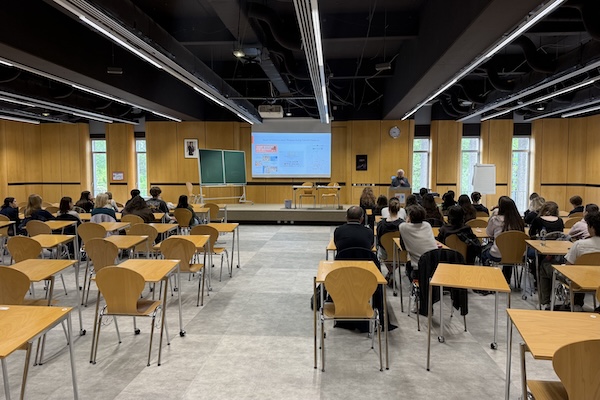
On Tuesday 5 May 2026, the association of Ukrainians in Luxembourg, LUkraine Asbl, held the third event within its “Advocacy Coalition – Defending Our Future Now” project, in the form of a workshop titled “The Smartphone as Historian – Smartphones for Justice and Freedom” at the University of Luxembourg’s Kirchberg Campus, for around 40 students.
The event, organised by the Embassy of Germany in Luxembourg in cooperation with the Luxembourg Centre for Contemporary and Digital History, was held in the presence of Charles Delogne, Ambassador of Belgium to Luxembourg, Barbara Karpetová, Ambassador of the Czech Republic to Luxembourg, and the German Ambassador to Luxembourg, Dr Heike Peitsch, and was aimed at students aged sixteen and above.
“Last year, a group of embassies in Luxembourg, together with the European Commission and the Embassy of Ukraine, launched the ‘Advocacy Coalition’ project to organise regular events related to Ukraine’s fight for democracy. We believe that Ukraine’s fight is also our fight,” said Dr Heike Peitsch, speaking to Chronicle.lu. “We wanted to engage students and raise awareness of the importance of documenting and archiving experiences, particularly in the context of war and displacement. Smartphones have become a key tool in this process, but it is essential to ensure standards so that such material can be used reliably in the future.”
She added that the workshop aimed to encourage students to reflect on the role of documentation in preserving historical evidence, including potential war crimes, and to highlight the growing importance of digital tools in historical research.
The workshop began with an introduction by Machteld Venken, Professor of Contemporary Transnational History at the Luxembourg Centre for Contemporary and Digital History (C²DH), who presented the topic and outlined the role of smartphones in documenting contemporary events. Participants first viewed a short documentary, which served as the basis for the subsequent discussions and practical exercises.
Following the screening, students were divided into three groups to work on different aspects of the topic in smaller sessions, guided by facilitators, using their smartphones as practical tools throughout the workshop.
Iryna Yeroshko, Doctoral Researcher at C²DH, told Chronicle.lu that the three workshops were designed to demonstrate how smartphones can be used as tools for documenting everyday life and creating historical evidence.
The first workshop, led by Dr Inna Ganschow, Research Scientist at C²DH, focused on daily smartphone use. “The idea was to show students how their phones can be used differently from what they are used to, and how historians rely on the same tools, but with different objectives,” Iryna Yeroshko explained. Through an exercise titled “My Morning”, participants explored how frequently they use their phones in everyday routines and how much digital data they generate, often without realising it.
A second workshop centred on the use of photographs. Students were asked to select one of the oldest images on their phones and provide context to a peer. “This showed that context is essential to understand what is happening in a photo – details such as location, date or visual clues are often needed, and sometimes even that is not enough,” she noted.
The third workshop, led by Professor Machteld Venken, focused on audio recordings and testimonies. “It is important to obtain consent, and people have the right to withdraw it at any time,” Yeroshko said, adding that the session also addressed the relevance of the General Data Protection Regulation (GDPR) when collecting and using personal data.
After nearly 90 minutes, the speakers and students exchanged impressions of the workshop. Prof Andreas Fickers, Director of the C²DH, also addressed participants, highlighting the importance of engaging beyond academia and working with wider audiences. Referring to a Swedish colleague’s work on Big Data, he shared a key message with the students: “If content is king, context is its crown. So remember that.”
The workshop formed part of a broader series of events aimed at raising awareness of Ukraine’s war and the role of digital tools in documenting it.