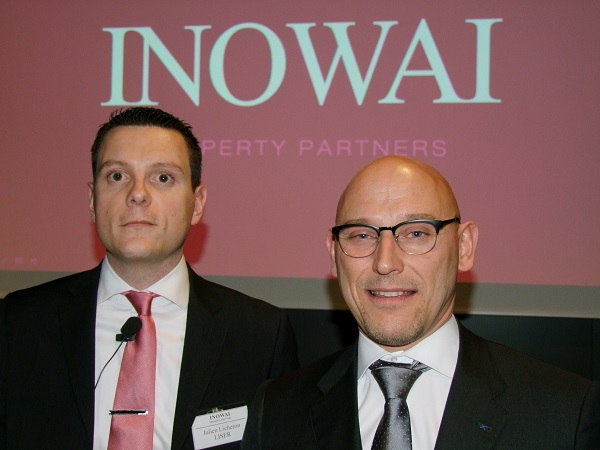
At the Inowai Annual Conference held in Kirchberg on Thursday evening, Julien Licheron, Team Leader Housing Observatory at LISER (Luxembourg Institute of Socio-Economic Research), presented an overview of the real estate market in Luxembourg.
Average house prices in Luxembourg have risen 3.9% annually from 2008 to 2015, representing a total growth rate of 34.3%. The prices of newly-built apartments have risen at 4.5%, existing houses at 3.9% and existing apartments at a lower rate.
In comparison to other countries, the increase has been much higher in the Grand Duchy and steadier than the average European growth rate, at circa 25% since 2007.
He explained that the prices vary across the country, with prices in the north, e.g. Clervaux, 50% of those in Luxembourg city, and those in Esch-sur-Alzette between the two. The main reasons are land prices and the value put on commuting times, as well as urban amenities, socio-economic composition and housing stock composition. Prices also vary for type of building, with a current figure of €4,449/m2 for existing apartments.
Jean-Nicolas Montrieux, COO INOWAI Residential, addressed the issue of the supply and demand balance, with the government expecting the population to grow to 650,000 by 2025, meaning a doubling of the population since 1960. Currently the population stands at 560,0000, with Luxembourg nationals at 54%. People mainly come to Luxembourg because of economic reasons. This represents a population increase of 2% annually, or 12,000 new people arriving each year, leading to a need of 4,800 new dwellings annually. In 2014, around 4,000 new dwellings were constructed, with half for existing residents, meaning a need to build 2,800 more housing units annually than the 4,000 in 2014.
In addition, new infrastructure and services are needed, which he described as a national challenge; however, there are very strict building regulations in force in the Grand Duchy. The city of Luxembourg now has 111,300 residents. He acknowledged that investment in real estate is a challenge, with higher deposits and guarantees demanded by financial lending institutions. Currently, Luxembourg home owners pay 36% of their income on housing.
Photo by Geoff Thompson (L-R): Julien Licheron, LISER; Vincent Bechet, INOWAI