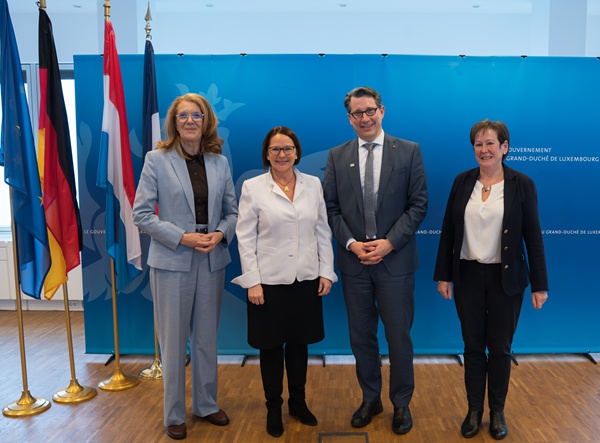
 (L-R) Petra Berg, Saarland Minister; Yuriko Backes, Luxembourg's Minister for Mobility & Public Works; Michael Hauer, Rhineland-Palatinate State Secretary; Evelyne Isinger, Grand Est Regional Councillor;
Credit: MMTP
(L-R) Petra Berg, Saarland Minister; Yuriko Backes, Luxembourg's Minister for Mobility & Public Works; Michael Hauer, Rhineland-Palatinate State Secretary; Evelyne Isinger, Grand Est Regional Councillor;
Credit: MMTP
On Friday 6 February 2026, Luxembourg's Minister for Mobility and Public Works, Yuriko Backes, hosted Saarland's Minister for the Environment, Climate, Mobility, Agriculture and Consumer Protection, Petra Berg, Rhineland-Palatinate's State Secretary at the Ministry for Climate Protection, Environment, Energy and Mobility, Michael Hauer, and the Regional Councillor representing the President of the Grand Est Region, Evelyne Isinger, for a working meeting on strengthening cross-border cooperation in the field of mobility.
In a joint press release, the authorities noted that no other region in the European Union has as many cross-border workers as the Greater Region. In 2024, 276,360 people, the vast majority of whom work in Luxembourg, crossed borders daily to reach their workplaces. According to the authorities, these significant flows create undeniable interdependence between the various entities of the Greater Region, particularly in the areas of mobility and transport infrastructure, especially rail. Against this backdrop, the partners stressed the importance of citizens benefiting from a high-performing, cross-border and supra-regional public transport network. To achieve this objective, the Greater Region partners are committed to the joint and coordinated development of infrastructure and services within their respective areas of responsibility.
Significant investments are currently underway to strengthen services both within the region and across borders, contributing to improvements in public transport across the interconnected territories.
For the first time, a joint study involving Luxembourg, the German Länder (states) of Rhineland-Palatinate and Saarland and the Grand Est region in France has been completed. The study provides an up-to-date factual basis to further support existing cooperation and to give fresh momentum to the strategic development of future cross-border rail links.
According to the authorities, the study confirms the feasibility in principle of a direct rail connection between Luxembourg, Saarbrücken and Mannheim, while also identifying technical, infrastructural, legal and financial challenges. Implementation would therefore only be possible gradually and in stages. The partners said they are prioritising a joint solution to establish long-distance rail connections between Luxembourg, Saarbrücken and Mannheim, which would be integrated into the German and European long-distance rail networks.
Establishing a direct connection in the form of a regular regional service would require a longer preparation period and, subject to the agreement of all partners, would only be possible from the mid-2030s at the earliest.
For Saarland and Rhineland-Palatinate, financing would also depend on the development of regionalisation funds made available by the federal government to the Länder to support regional passenger rail services.
Following the meeting, the four partners reaffirmed their commitment to continuing cooperation based on shared responsibility in order to jointly address the identified challenges. The reported goal is to progressively strengthen rail services by offering sustainable transport solutions for the benefit of the Greater Region's population.
The partners also approved the establishment of a technical working group, designed to facilitate regular exchanges on best practices and feedback, as well as on issues related to public transport safety.
Shorter-term options will also be examined, including an in-depth analysis of occasional long-distance connections and a study into extending certain existing long-distance routes, such as the connection between Luxembourg and Saarbrücken. These considerations will be carried out in consultation with operators on both sides of the border and will take into account the needs and expectations of customers, as identified through the Luxmobil 2025 survey conducted at the national (Luxembourg) and cross-border levels.