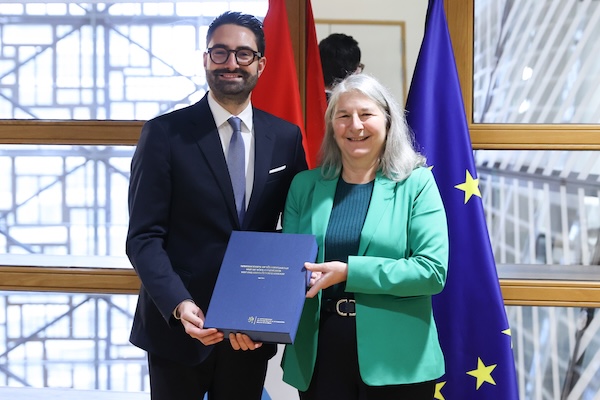
 (L-R) Eric Thill, Eric Thill, Luxembourg’s Minister for Culture; Thérèse Blanchet, Secretary-General of the Council of the European Union;
Credit: European Union
(L-R) Eric Thill, Eric Thill, Luxembourg’s Minister for Culture; Thérèse Blanchet, Secretary-General of the Council of the European Union;
Credit: European Union
On Tuesday 2 December 2025, during a public session of the Chamber of Deputies, Luxembourg’s Minister of Culture, Eric Thill, presented the Chamber with the certified Luxembourgish translation of the European Union’s four foundational texts.
These documents, translated in accordance with Article 55(2) of the Treaty on European Union, comprise the Charter of Fundamental Rights of the European Union, the Treaty establishing the European Atomic Energy Community, the Treaty on the Functioning of the European Union and the Treaty on European Union.
According to the Ministry of Culture, in his statement, Minister Eric Thill recalled that the new Constitution of 1 July 2023 includes, for the first time, a passage on languages, and specifically on the Luxembourgish language. Article 4 stipulates: "The language of the Grand Duchy of Luxembourg is Luxembourgish."
Minister Thill added that “the anchoring of Luxembourgish in the Constitution is an important step towards its valorisation on the international stage and enables a new reflection on its role at the European level.”
The ministry further noted that Minister Thill also referred to the action plan for the Luxembourgish language, based on the 2018 law on the promotion of Luxembourgish, whose 25th measure explicitly aims to promote the language within the European Union and the Council of Europe. In this context, Minister Thill met last Friday 28 November 2025 in Brussels, on the sidelines of the meeting of the EU Council of Ministers for Culture, with the Secretary-General of the Council of the European Union, Thérèse Blanchet, to present her with the first certified Luxembourgish translation of the aforementioned texts, as well as a Luxembourgish translation of the Constitution.
Minister Thill emphasised that “this represents a decisive step for the visibility of our language at both the European and national levels. This confirms the role of Luxembourgish and multilingualism, which together constitute the exceptional nature of our society and our state. The initiative also demonstrates Luxembourg's commitment and willingness to preserve and strengthen the linguistic and cultural diversity of the EU.”
During his address to the Luxembourgish deputies, Minister Thill stressed that these translations offer the Luxembourgish state an opportunity to engage in more in-depth discussions regarding the place of Luxembourgish within the European institutions. He clarified, however, that this initiative does not constitute a request for Luxembourgish to obtain the status of an official EU language. In line with the multilingualism that characterises the country, the government is instead pursuing a measured and nuanced approach aimed at further valorising Luxembourgish within the European institutions and strengthening its presence in the broader European linguistic landscape.