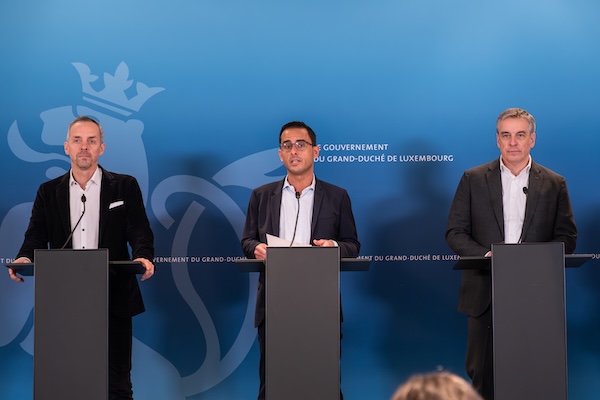
 (L-R) Georges Mischo, Luxembourg's Minister of Labour; Max Hahn, Luxembourg's Minister for Family Affairs, Solidarity, Living Together and Reception of Refugees; Claude Meisch, Luxembourg's Minister of Education, Children and Youth, Minister of Housing;
Credit: Ali Sahib, Chronicle.lu
(L-R) Georges Mischo, Luxembourg's Minister of Labour; Max Hahn, Luxembourg's Minister for Family Affairs, Solidarity, Living Together and Reception of Refugees; Claude Meisch, Luxembourg's Minister of Education, Children and Youth, Minister of Housing;
Credit: Ali Sahib, Chronicle.lu
On Monday 1 December 2025, Luxembourg presented its first national action plan for the implementation of the International Convention on the Elimination of All Forms of Racial Discrimination.
Luxembourg's Minister for Family Affairs, Solidarity, Living Together and Reception of Refugees, Max Hahn, the Minister of Labour, Georges Mischo, and the Minister of Education, Children and Youth and Minister of Housing and Spatial Planning, Claude Meisch, presented the plan at a press conference on Monday afternoon.
Following a debate on racism in the Chamber of Deputies (Luxembourg's parliament) and the adoption of a related motion, Luxembourg's Ministry of Family Affairs, Solidarity, Living Together and Reception of Refugees commissioned a study in 2020 from CEFIS and LISER to analyse the situation in Luxembourg. Published in 2022, the study showed that racism remains a reality in the Grand Duchy. It revealed that people of African descent most frequently report experiencing discrimination, particularly in education, employment and housing.
Based on these findings, the Family Affairs Ministry developed the action plan, in collaboration with twelve other ministries and in close consultation with civil society, human rights institutions and affected individuals. The plan also aligns with the International Convention on the Elimination of All Forms of Racial Discrimination, which Luxembourg intends to implement systematically and in a coordinated manner for the first time.
Minister Hahn explained that the plan was developed in line with international recommendations and following a broad consultation process. Split into six chapters, the plan contains 23 objectives and 118 actions aimed at combating racism and all forms of racial discrimination in a coordinated and cross-cutting manner. It proposes concrete measures in the areas of employment, education and housing, as well as awareness-raising, data collection and support for victims.
Minister Hahn noted the importance of data collection to build a clearer picture of the situation. He emphasised that racism is not always obvious, citing micro-aggressions and everyday racism, which also need to be addressed, for example through public awareness campaigns and training for professionals. He stressed the aim of building a strong alliance between private and public actors to demonstrate zero tolerance for racial discrimination. Municipalities are considered important partners, with the plan foreseeing toolkits and best practice guidance; local non-profit organisations are also key partners in the continued fight against racism.
"Racism has no place in a multicultural country like Luxembourg. With this plan, the government reaffirms its firm commitment to building an inclusive society, characterised by mutual respect, tolerance and solidarity as the foundations of our living together. Everyone must be able to find their place in Luxembourg, regardless of their origins," emphasised Minister Hahn.
Minister Mischo highlighted upcoming measures in the labour market, including anti-racism training for ADEM staff by 2027 and campaigns by the Inspectorate of Labour and Mines (ITM) to combat workplace discrimination.
Minister Meisch addressed measures in education and housing. He noted that schools are both places where discrimination can occur and where prevention must begin. Schools must be able to meet the needs of a highly diverse student population to offer all students equal opportunities for success, regardless of background, nationality or skin colour. Housing is another sector in which racial discrimination is still reported. To address this, it is essential to raise awareness, inform and train professionals in this sector (e.g. real estate agents), as well as to collect information to better understand the current situation.
Concrete measures outlined in the plan include:
- the implementation of a single point-of-contact project offering guidance, a safe space for dialogue among those affected and advice on victim support services and complaint procedures;
- the creation of an "I am committed to fighting racism" ("Je m'engage contre le racisme") label for the private and public sectors, based on strict criteria;
- the development of anti-racism training for professionals in various fields;
- the implementation of public awareness campaigns developed in close collaboration with people affected by racism.
To ensure effective implementation and rigorous monitoring, the plan includes specific indicators and a timeline for each action. It also creates a clear governance structure, comprising two bodies: an interministerial steering group bringing together the contact points from all involved ministries; a monitoring group composed of representatives from civil society organisations, human rights institutions and the High Council ("Conseil supérieur") for Intercultural Living Together.
Closing the presentation, Minister Hahn emphasised that the fight against racism is a long-term, collective effort. This action plan represents an important step, he said, but work must continue daily.
The press conference concluded with a Q&A session.