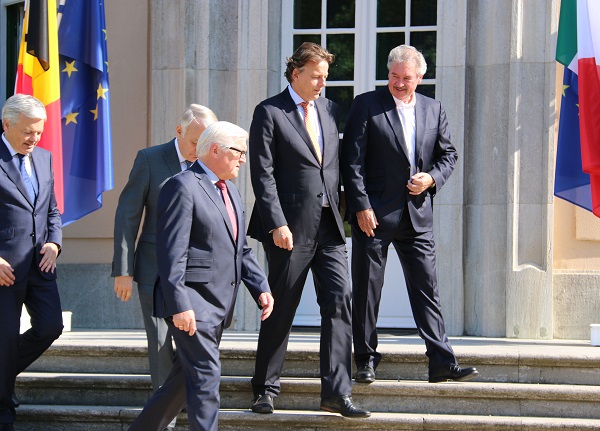
After it was announced on Friday that the British population had voted 51.9%-48.1% to leave the European Union, Foreign Minister of Germany, Frank-Walter Steinmeier, gathered his counterparts from the other five founding countries of the EU on Saturday in Berlin to discuss strengthening the Union's internal cohesion by returning to the fundamental principles behind European integration.
France's Jean-Marc Ayrault, the Netherlands' Bert Koenders, Italy's Paolo Gentiloni, Belgium's Didier Reynders and Luxembourg's Jean Asselborn examined the outcome of the British referendum in which a narrow majority of voters came out in favour of releasing the UK from the EU.
In a joint statement adopted at the conclusion of their meeting, the Ministers stated that the British people have spoke out against EU membership ad felt that "the decision of the British people marks a turning point in the history of Europe". For the six founders, "the EU is not only losing a Member State, but a large part of history, tradition and experience".
With no precedence to use as a reference, the outcome of the referendum "creates a new situation". A consequence of the decision is that the agreement of the European Council on 18 and 19 February 2016 is obsolete. The six founding countries now expect the UK government to "clarify the situations and do so as quickly as possible to monitor the effects of this decision."
"I hope we will not play cat and mouse," stated Minister Asselborn, explaining that "it is now necessary that the mechanism of Article 50 be quickly implemented to avoid a period of uncertainty and ensure a separation that is fair to the EU and the UK."
The ministers expressed their readiness to work with the institutions from moment that negotiations to clarify and define future relations between the EU and UK begin.
They stated their belief that "the EU provides a historically unique and indispensable framework for the maintenance of freedom, prosperity and security in Europe, to develop peaceful and mutually beneficial relations between its people and to contribute to peace and to stability in the world."
The ministers of the six founding nations cited the EU as the instigating factor of the continent's longest period of peace since the beginning of the modern era, speaking of the "main promise to which we are committed: to create an ever closer union among the peoples of Europe" before pledging "we will not stop our efforts to work for a stronger and more united European Union of 27 based on shared values and the rule of law".
But the ministers also revealed some flexibility in that commitment, stating: "This is why we will also recognise different levels of amibition among Member States regarding the European integration project. Without repeating what we have already achieved, we must find better way to deal with these different levels of ambition so that Europe can better meet the expectations of all European citizens."
Ministers claimed that they were "aware of the dissatisfaction with the functioning of the EU which is now evident in parts of our societies". They explained that "the appropriate response can not be a simple call for more Europe or a phase of reflection. We must focus our efforts on the challenged that must be addressed with common European responses when we leave the other tasks to be dealt with at national or regional levels. We need better answers to questions we have decided to deal with at the EU level. And we must accept our responsibility to strengthen solidarity and cohesion within the EU."
The Six listed the major challenges the EU will face "in a globalised world" and in a growing context of instability and geopolitical change at Europe's borders: to ensure the security of citizens facing increasing threats both from outside as well as within; to create a stable and cooperative framework for dealing with migration and refugee flows; to revive the European economy through the convergence of economies, sustainable growth and job creation, going towards completing the Monetary Union.
On Friday, Luxembourg Prime Minister and Minister of State, Xavier Bettel, met with President of the European Council, Donald Tusk, in Brussels, to discuss the consequences of the referendum and prepare for the European Council which will take place on 28 and 29 June 2016, as well as the informal meeting of the heads of state and government which will be held on the second day of the Council.
Photos by MAEE (Top): Jean Asselborn (far right) with his counterparts of the five founding countries of the EU. Bottom (L-R): Donald Tusk; Xavier Bettel