Improved food products, the fight against antimicrobial resistance, access to medicine and medical devices were on the agenda at the Health component of the "Employment, Social Policy, Health and Consumer Affairs" (EPSCO) Council held in Luxembourg on Friday.
A broad consensus was found among the 28 EU Health Ministers, including Luxembourg's Lydia Mutsch, regarding the need to offer all citizens the means to access healthy foods, as recommended by the WHO as part of the fight against obesity. Member States were invited to submit, up until the end of 2017, national action plans to reduce the rates of salt and added sugars, the high energy value of food, whilst facilitating healthy choices.
Another challenge in the field of human and veterinary health is antibiotic resistance. To this end, Council conclusions were adopted with the aim of an active contribution of the Union in the fight against antimicrobial resistance.
Lydia Mutsch particularly welcomed the "One Health" multisectoral approach put forward by the Dutch Presidency and announced the launch of work on a national plan developed jointly by the Ministries of Health and Agriculture.
"In the coming years, we will have to mobilise all stakeholders to monitor the effectiveness of the new measures in places!" Minister Mutsch stated.
The topic that generated the most excitement was that of access to innovative medicines, which is in line with the discussions under the Luxembourg Presidency in relation to personalised medicine.
The Council enabled those present to reach common awareness on the need to join forced to improve medicine prices as well as time-to-market innovative products. The Commission will conduct a review of incentives in the legislative framework.
For Lydia Mutsch, "cooperating with other Member States on a voluntary basis and in respect of national competences, helps to create the conditions for a better balance between costs and access to quality medicines." The minister described the accession of Austria to the Benelux cooperation agreement on the sidelines of the Council as a "perfect example" of the success of this kind of inter-state alliance.
The Council was also an opportunity for the Commission to introduce new criteria for endocrine disrupters, which have been expected for over two years.
The Dutch Presidency has been able to reach agreement with the European Parliament, after ten trialogues (five of which were under the Luxembourg Presidency), regarding medical devices and in vitro medical devices. After four years of negotiations, this issue has been a tour de force, and several member states have congratulated the Dutch Presidency for the agreement reached on the revision of the acquis on medical devices.
Finally, Ministers noted the candidacy of the former French Health Minister, Philippe Douste-Blazy, for the post of Director General of the World Health Organisation (WHO), which will be opened in 2017.
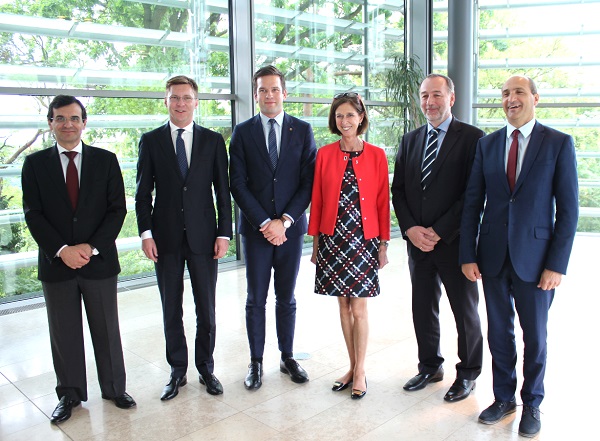
Photo by MSAN (L-R): Adalberto Campos Fernandes, Portuguese Minister of Health; Juras Požela, Lithuanian Minister of Health; Gabriel Wikström, Swedish Minister of Health; Lydia Mutsch, Minister of Health; Stanislav Spanik, Secretary of Slovak State for Health; Christopher Fearne, Maltese Minister of Health