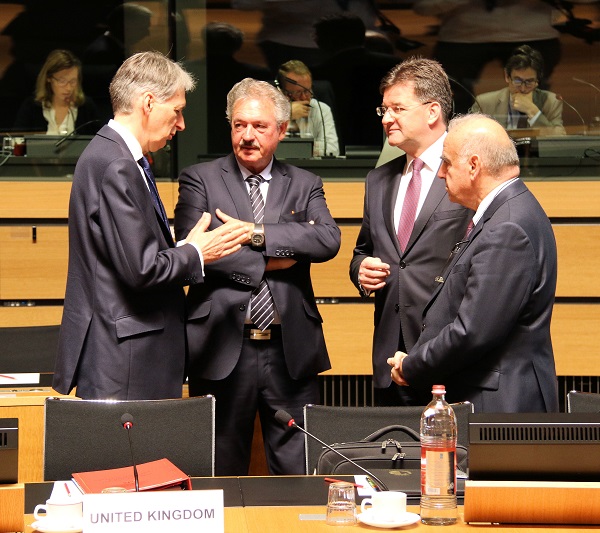
Jean Asselborn, Luxembourg's Minister of Foreign and European Affairs, participated in the "Foreign Affairs" Council of the European Union on Monday, where ministers discussed the situation in the Sahel and took stock of the overall approach on security and development in the region.
During the debate, Minister Asselborn emphasised that Luxembourg has now been present in the Sahel region for 20 years, through its development cooperation agreements, and that three countries of the region (Mali, Burkina Faso and Niger), are partner countries of the Luxembourg cooperation. Burkina Faso's President, Roch Marc Christian Kaboré, was recently received in Luxembourg to discuss the Indicative Cooperation Programme 2017-2021. Luxembourg invests primarily in rural development programmes, as well as training and professional integration.
In this context, Minister Asselborn recalled the work initiated in Valletta in November 2015 to develop mutually beneficial partnerships for the European Union and its partners in the region.
"The Valletta Summit allowed us to achieve a good balance; today, I have the distinct impression that we are distancing ourselves from this balance through negative conditionalities," the Luxembourg Minister commented. "The Valletta result is an achievement and our partners are at risk of seeing this new European turning point askance; the impact could be very negative on our relations with third countries."
The Foreign Affairs Council formally adopted the decision to extend the mandate of the EU NAVFOR MED Sophia operation for one year, and added two support tasks to the mandate: to train Libyan coastguards and the Libyan navy and to contribute to the implementation of the UN embargo on weapons on the high seas off the Libyan coast.
The ministers also discussed the situation in the former Yugoslav Republic of Macedonia, visa liberalisation in the context of EU-Georgia relations, and discussed the peace process in the Middle East.
Photo by MAEE