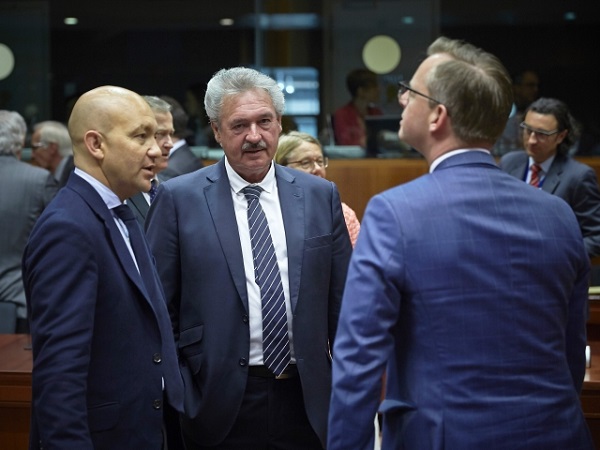
On Friday 13 May 2016, Minister Jean Asselborn attended the Foreign Affairs Council - Trade on behalf of Luxembourg.
The Council discussed the follow-up to the Ministerial Conference of the World Trade Organisation which took place in Nairobi in December 2015, analysing in particular the outstanding issues under the Doha Development Agenda and new issues to be addressed by the WTO, such as digital commerce.
The ministers made an inventory of negotiations with the United States regarding the establishment of a Transatlantic Trade and Investment Partnership (TTIP), with an update on the results of the 13th round of negotiations and the recent political discussions between Commissioner Cecilia Malmström and trade representative of President Obama, Michael Froman.
They also held a round table on the next steps for the EU-Canada Comprehensive Economic and Trade Agreement (CETA/AACC). Whilst emphasising the important of strengthening economic relations in the mutual interest of the EU and Canada, Luxembourg Minister of Foreign and European Affairs, Jean Asselborn, expressed a certain number of concerns experienced by Luxembourg and European civil society. In this context, Jean Asselborn called for the involvement of national parliaments, highlighting the dual legal nature of the AACC.
The Council then discussed the current crisis in the European steel industry, with Minister Asselborn advocating a conclusion of the process reforming the trade defense instruments to enable the EU to more effectively defend itself in compliance with WTO rules against sold-off imports from certain third countries.
"We are now facing an existential crisis in Europe - an industry base upon which hundreds of thousands of direct and indirect jobs depend," commented Minister Asselborn. "It is not about protecting a specific industry from foreign competition but safeguarding maximum sustainable employment whilst allowing our industries to find ways to stay competitive."
He continued: "After the meeting, during our Presidency, of an extraordinary Competitiveness Council at the request of the United Kingdom, followed by several crisis meetings, particularly a European Council, after deliberations in the European Parliament, on Tuesday, the policy option of doing nothing is no longer an option: it is quite simply the Council's credibility at stake! So I hope that we will manage to, in a spirit of European solidarity, bridge the ideological divides that separate us on such an important issue and conclude a compromise to enter into a trialogue."
Over lunch, ministers exchanged views on parameters for progress in negotiations with the European Parliament on minerals from conflict zones, leaning on a proposal to minimise the risk of financing armed groups by selling minerals and metals from areas affected by conflict.
Minister Asselborn reaffirmed the aim as finding a compromise to actively fight against the exploitation of entire populations and illegal financing of conflicts around the three minerals and gold affected by this regulation, whilst ensuring sustainable access for EU traders to the raw materials necessary for the competitiveness of whole sectors of the economy.
"Our goal after and above all is the sustainable and social development of the regions involved in conflict," the Luxembourg Minister commented. "Now, if our operators are leaving these areas because of a regulation that is impossible to be implemented, we will not solve the problem. These regions will be plagued by less scrupulous third country operators and Europe's procurement of these minerals will also be questioned."
Minister Asselborn concluded: "We need to find an effective and easy way to implement regulations, and uniformly throughout the European Union to avoid loopholes in the system. This is why my delegation defended the establishment of a European authority throughout the discussions in the Council."
Photo by EU (L-R): Jaime GARCIA-LEGAZ PONCE, Spanish State Secretary for Trade; Jean ASSELBORN, Luxembourg Minister for Foreign and European Affairs, Minister for Immigration and asylum; Mikael DAMBERG, Swedish Minister for Enterprise.