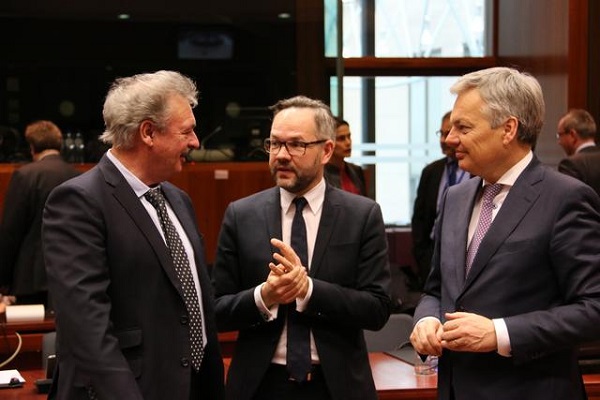
Jean Asselborn was in Brussels on Monday to participate in the Foreign Affairs Council (FAC) of the European Union.
The Luxembourg Minister of Foreign and European Affairs participated in discussions of relations with Russia, through which the Council unanimously agreed on five principles to guide the EU's policy towards the Federation. The Minsk agreement will consequently be implemented as the main condiiton for any substantial change in the EU's stance towards Russia. The EU will also look to strengthen relations with Eastern and Central Asian partners, as well as reaffirm its resilience with regards to energy security, hybrid threats or strategic communication. It was also found that there is a need to selectively engage with Russia on issues of interest to the EU and support the country's civil society.
Ministers also looked to resume cooperation with Iran following the adoption of the Joint Comprehensive Plan of Action and the lifting of nuclear-related EU sanctions. High Representative for Foreign Affairs and Security Policy, Federica Mogherini, highlighted a trip to Tehran which she and a delegation of Commisioners plan to take in mid-April in order to further explore potential areas for cooperation with Iran. Sectors to be focused on will include trade and investment, energy, transport, environment, migration, human rights, the fight against drugs as well as research and development.
Special Representative of the United Nations Secretary-General, Martin Kobler, joined the ministers to discuss the latest developments in Libya. They took stock of the political situation, exchanging views on the capacity of the EU to rapidly promote the formation of a government of national unity.
With regards to the Cotonou agreement, the Council found that commitments proposed by the Burundian government were insufficient in addressing EU concerns and took the decision to suspend direct financial support thereto. Financial support to the population and humanitarian assistance will be maintained.
"The situation in Burundi remains of serious concern for the EU, though we have seen recently some glimpses of hope," commented Federica Mogherini. "Today's decision makes clear that for our relations to be fully resumed we expect a number of concrete measures to be carried out. The action we are seeking is achievable with will and determination: it builds on measures and processes set in motion by the African Union, the East African Community and the United Nations, and welcomed by the 5 African Heads of State mandated by the African Union."
Finally, the Council discussed the possibilities of restarting a peace process in the Middle East.
"It is the total absence of a credible political horizon that led to the current violence," remarked Minister Asselborn. "We must mobilise the international community to show that it is following this issue very closely. This is a central issue for the region as the Israeli-Palestinian conflict is a flashpoint, which feeds the radicalisation of young people in the Middle East and Europe."
Top photo by MAEE (L-R: Minister of Foreign and European Affairs of Luxembourg, Jean Asselborn; German Secretary of State for Foreign Affairs, Michael Roth; Minister of Foreign Affairs of Belgium, Didier Reynders)
Bottom photo by European Union (High Representative for Foreign Affairs and Security Policy, Federica Mogherini)