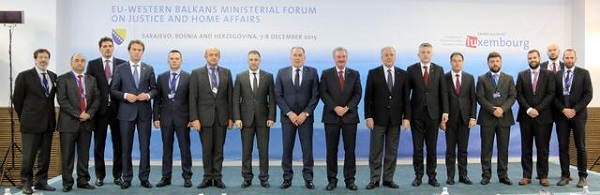
On Monday 7 December 2015, Luxembourg Minister of Foreign and European Affairs, Minister of Immigration and Asylum, Jean Asselborn, chaired the ministerial 'Justice and Home Affairs' Forum of the European Union and the Western Balkans in Sarajevo.
The 'migration' section of the meeting allowed for an in-depth debate with Western Balkans partners on current issues, particularly the management of the migratory flux and foreseeable actions to overcome difficulties on the ground.
"Such a crisis cannot be solved in isolation; the responsiblity must be shared and cooperation among all States and relevant stakeholders is of utmost importance," emphasised Minister Asselborn - echoing his previous statements made on the matter in recent months. "It is necessary, in this migration crisis, to move forward in total logic and act on several fronts at the same time, as both the causes of migration and the possible solutions have effects which interact with each other."
Discussions focused on ways of strengthening cooperation in general with the Western Balkan countries, with a view to better managing the situation of refugees and migrants along the 'Balkan route' and improving communication between neighbouring countries so as to avoid unilateral decisions impacting other countries.
Ministers present also spoke of the liberalisation of visas between the EU and the countries of the west Balkans. Recalling that asylum applications from western Balkans states lie in fourth place after Syria, Afghanistan and Iraq, Jean Asselborn stated "However, visa liberalisation is a significant achievement for Western Balkans countries". The Minister lauded the latter for intensifying their efforts to reduce the asylum applications of their citizens in the European Union, that a number of information campaigns have been launched, that cooperation on return and readmission has been improved and that border controls were strengthened.
However, the new border controls implemented in mid-November by the governments of Macedonia, Serbia and Croatia have come under fire by human rights groups such as Amnesty International, which decreed the changes as "large-scale renewed human rights violations" with people arriving from actives conflict zones allowed to pass the Greece-Macedonia border and thousands of others left stranded.
Poor weather conditions preventing the Deputy Prime Minister, Minister of Internal Security, Étienne Schneider from attending the Forum resulted in Minister Asselborn also chairing the 'internal security' component of the Ministerial Forum. Discussions centrally focused on action against terrorism and the fight against the illicit trafficking of firearms and explosives, as well as on strengthening the EU's external borders.
Photo by MAEE