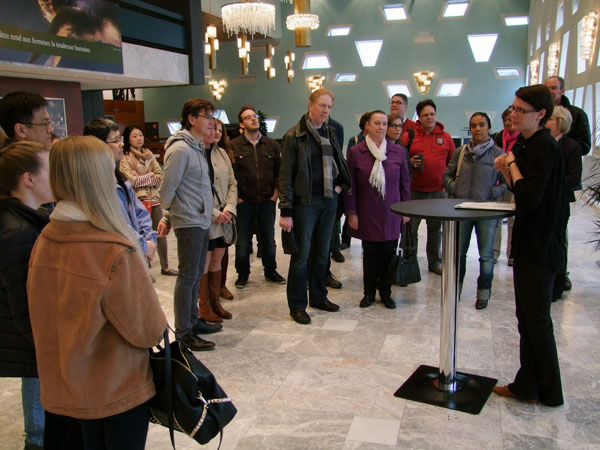
On Saturday morning, a 30-strong group met at the Grand Theatre in Limpertsberg for a behind-the-scenes tour of the capital city's magnificent threatre complex.
The group, organised by The Luxembourg Chronicle and including members of the British Ladies Club (BLC) and American Women's Club of Luxembourg (AWCL), were treated to a 1 hour 45 minutes tour of the facility which addressed both the infrastructure of the theatre itself as well as an overview of how the theatre production business works.
The group listened attentively to tour-guide Manon who usually works on the promotions side of the theatre and liaison with schools. She explained how the Théâtre des Capucins was built in the early 17th century as a church and convent and in 1869 it was transformed into a theatre. It was closed in 1964 and reopened in 1985.
Meanwhile, in April 1964, the Ville de Luxembourg opened the Grand Theatre as a venue to host productions too large for the Capucins, including ballet and opera. The original architect left following a disagreement with the city, with the city architect left to complete the project with the help of outside experts.
The Grand Theatre is part of the administration of the Ville de Luxembourg and puts on annual programmes covering drama, ballet and opera, in various languages, with English-language productions becoming more prevalent. The city continues to invest in the facility, ensuring that it will attract top international productions, as well as serving as a suitable venue for home-grown productions too.
At the time of the renovations, the chandeliers in the 1st floor foyer were presented as a gift from the royal family. The largest weighs 5 tonnes.
The tour visited both the Studio which holds an audience of up to 280 and is ideal for theatre. The Grand Salle seats up tp 950, with private boxes for the royal family (they prefer to sit in with the main audience, with the royal box mainly used for sound technicians), the director and the city Mayor. The main stage (14m x 14m, with a 28m-high tower) also doubles up as a second theatre, with seating of 260 behind allowing for a third option.
The tour groupo also learnt many things about the acoustics and lighting (the theatre has 2,000 spotlights), as well as the three types of water safety systems, as well as the 9m high space under the stage, of which parts can be raised and lowered as required.
The theatre employs around 80 staff, of which half are technicians.
Photos by Geoff THOMPSON