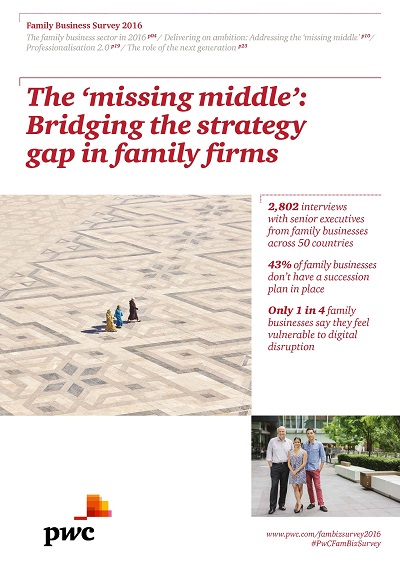
PwC recently addressed 2,800 family businesses from 50 different countries in its global "The Missing Middle: Bridging the Gap in Family Firms" survey.
This study reveals that 64% of family businesses surveyed have experienced strong growth over the past year, despite an economic context marked by major transformations. Only one company in five has seen a decline in sales over the past two years. European family-run businesses are forecasting stable growth, with the majority of respondents advocating steady development rather than rapid and aggressive growth.
The strategic agenda in line
Despite relatively stable overall trends, the report emphasises that strategic agenda plays a key role in the growth prospects of organizations. Today, uncertainty in the economic environment and external concerns are no longer a major risk for family businesses. Many problems currently facing family businesses are linked to the strategic agenda - the "missing link" - that will enable the company to realise its vision.
Although some family businesses manage their strategic agenda effectively, many find themselves lost under the burden of everyday tasks, hampering them in the implementation of their goals. In its survey, PwC found that succession, diversification, digital, cybersecurity and innovation are all too often overlooked.
According to Christophe Loly, partner at PwC Luxembourg, "the performance and growth prospects of family businesses remain solid overall, but the strategic agenda is a major challenge. Wanting to develop without a precise plan can limit organisations in their expansion aspirations, but also expose them to risks for which they are not prepared."
The companies surveyed identified a number of major challenges related to their strategic planning:
• Succession: only 16% of family businesses have established a transmission plan for senior executives. Organising its succession will ensure the sustainability of the activities and will ensure that the objectives of the family, the owner and the company are properly aligned in the long term.
• Innovation: 64% of respondents identify innovation as a major challenge in the next five years.
• Digital: 47% say that the acceleration of digital and new technologies is one of their main challenges, but only a quarter think their company is vulnerable to digital disruptions.
• Intrapreneurship: Three out of five respondents indicated that they would integrate professionals from outside the family to help them manage their business.
• Skills: 58% believe that their ability to attract and retain talent will be a major challenge over the next five years.
• Financing: one-third (32%) report having more difficulties accessing capital than their counterparts in non-family businesses. Three-quarters (76%) plan to use their own capital to finance their growth.
• Cybersecurity: 45% believe their organisation is ready to face a data theft or cyber attack.
• Brexit: this event does not seem to affect the growth ambitions of the companies surveyed. Fears of the consequences of the Brexit over the next two years were not surprisingly higher in the United Kingdom (38% - more than double the world average of 15%) and among the European Union countries (22% ).
• NextGen: the next generation is confident that it will have to work more to prove itself (88%) than the current generation (66%).
On this last point, Christophe Loly added "Succession is a major issue in the future of a family business. This project must be part of a global process and be the result of an upstream reflection, guided by a shared vision within the family. The next generation will play a crucial role in shaping the future of the family business, especially to accompany it in its digital issues that are too often underestimated by current leaders. Sustained and listened to, it can become ambassador of the digital transformation of the company."