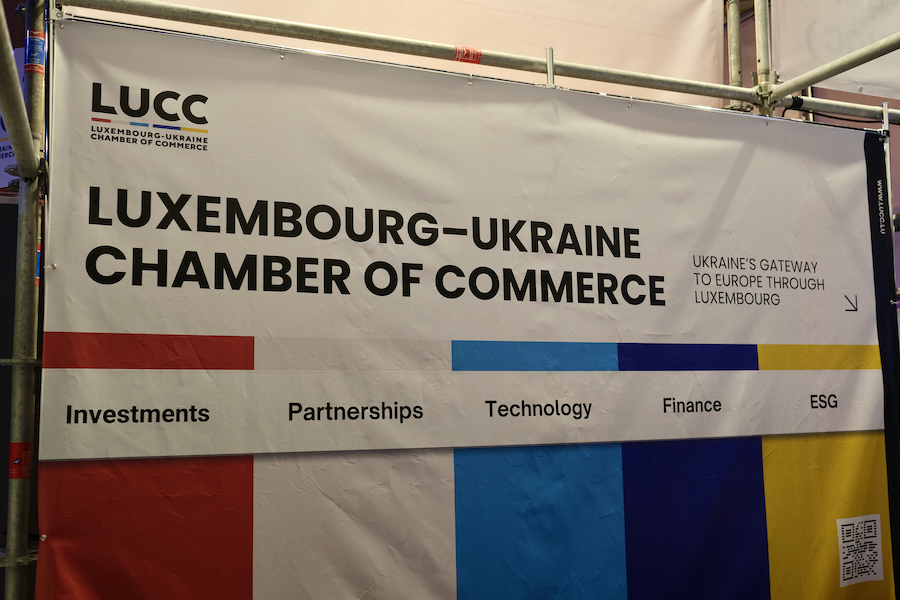
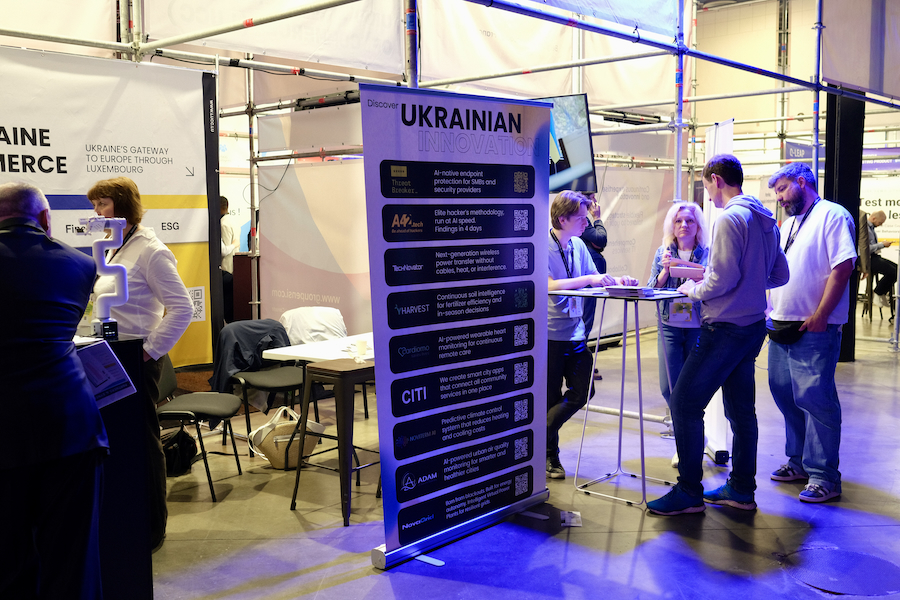
 The Luxembourg-Ukraine Chamber of Commerce (LUCC), supported ten Ukrainian companies active in cybersecurity, AI, data analytics, energy, smart buildings, GovTech, health tech, agri-tech, robotics and industrial innovation at NEXUS 2026;
Credit: Steven Miller, Chronicle.lu
The Luxembourg-Ukraine Chamber of Commerce (LUCC), supported ten Ukrainian companies active in cybersecurity, AI, data analytics, energy, smart buildings, GovTech, health tech, agri-tech, robotics and industrial innovation at NEXUS 2026;
Credit: Steven Miller, Chronicle.lu
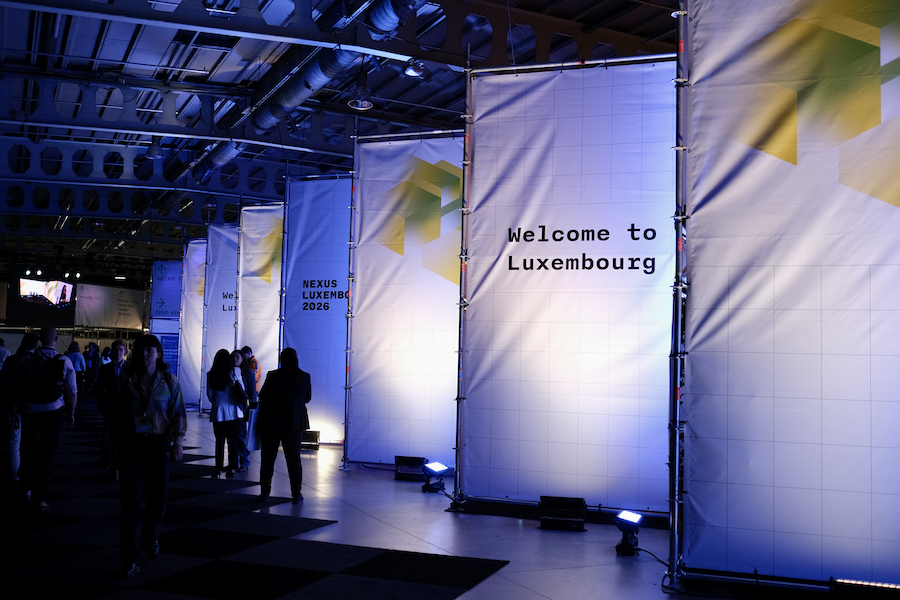
On Wednesday 10 June 2026, over 100 core exhibitors and over 250 startup and scaleup companies gather at LuxExpo The Box in Luxembourg-Kirchberg for the first day of Luxembourg’s two-day Nexus technology symposium.
This year saw Luxembourg’s flagship technology feature more than 150 speakers across five conference stages, with speakers including Prime Minister Luc Frieden, Deputy Prime Minister Xavier Bettel and a variety of ministers and high-profile representatives from the Grand Duchy’s technology scene.
According to the organisers, over 10,000 attendees participated in a programme covering topics including artificial intelligence, cybersecurity, autonomous systems, fintech, digital innovation and entrepreneurship, with various stalls and booths offering the opportunity for those in attendance to network and discover the last in emerging technologies.
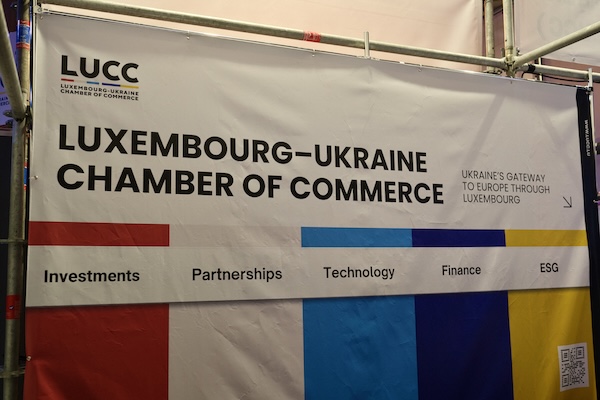
Among the contributors were the Luxembourg-Ukraine Chamber of Commerce (LUCC), who featured ten Ukrainian companies active in cybersecurity, AI, data analytics, energy, smart buildings, GovTech, health tech, agri-tech, robotics and industrial innovation. The startups included early-stage and revenue-generating companies developing solutions for endpoint security, AI-driven municipal services, remote patient monitoring, energy management, virtual power plants, precision agriculture and advanced manufacturing.
Chronicle.lu spoke to five of the Ukrainian companies about the technological solutions they presented at NEXUS 2026.
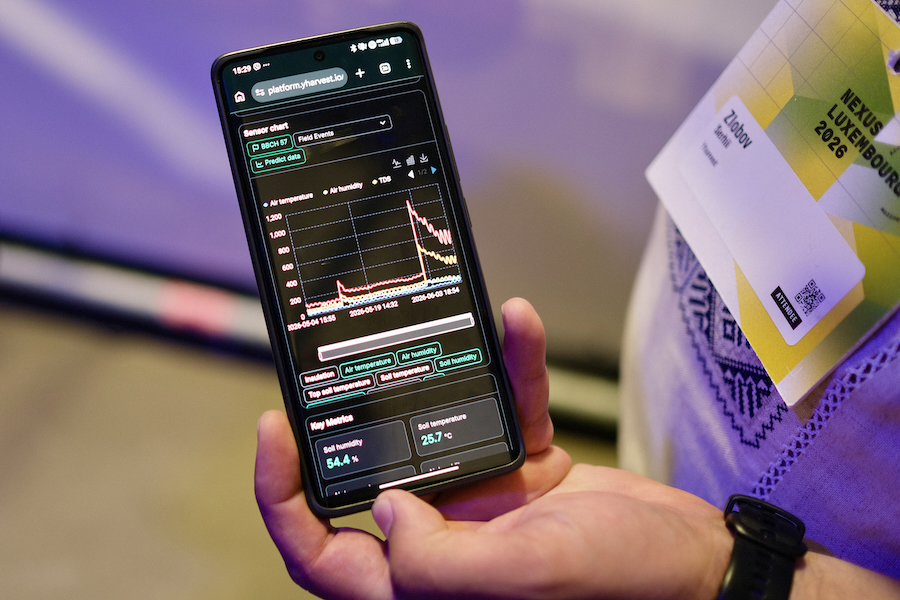
YHARVEST - YHarvest is a system for providing critical data for agricultural business including farming and viticulture. Through a system of sensors installed in fields and vineyards, YHarvest’s system monitors the temperature and moisture of the air and ground, as well as collecting chemical information on the soil (acidity, nutrients levels etc.) and measuring sunlight exposure. Collecting data throughout the day, the YHarvest system then uses bespoke algorithms to assess soil quality and its suitability for various crops. Key metrics are then provided via a dedicated app to allow farmers and landowners, giving them real-time access to information about the condition of the land and how to assess how best to utilise each part for cultivation.
Serhii Zlobov and Dmytro Bohovyi from YHarvest detailed that the project bean eighteen months ago and they are currently working with farms and partners in four areas of Ukraine. They also revealed that the company is currently in negotiations with vineyards in California, US and Mendoza, Argentina. Dmytro Bohovyi remarked: “We have a feeling that wine is a good starting point to the market.”
Threat Breaker - Threat Breaker is an AI-based agent which provides native endpoint protection for small-to-medium businesses and security providers. Company representative Kerych Roksolana explained that the system automatically manages and responds to any threat but also immediately instigates and automated investigative process when a threat is detected, saving IT security teams time by assessing the data during the threat and dealing with false positives.
Kerych Roksolana from Threat Breaker noted that with the introduction of the EU's NIS2 Directive (Network and Information Systems Directive 2), the EU's main cybersecurity law for critical and important organisations, Threat Breaker is a scalable and more affordable tool which can help smaller businesses meet their compliance requirements.
As the issue of cyberthreats increases across the world, Kerych Roksolana detailed that Threat Breaker’s large-language model AI system is trained on data supplied from one of the company’s angel investors, a large Ukrainian retail business which has experienced cyberattacks from Russia, making Threat Breaker “the only cybersecurity tool that knows how to deal with Russian hackers”.
A42.tech - A42.tech is a platform that automatically monitors a company's external perimeter – domains, subdomains, exposed services, detects data leaks and vulnerabilities before they can be exploited by attackers, and provides detailed feedback within four days.
Nina Glushchenko from A42.tech explained that the system has the ability to not only find existing vulnerabilities but can also assess any newly developed code, uncovering vulnerabilities that might appear before it is integrated into an existing system. Regular scheduling of scan allows the system to maintain a consistent overlook of a company’s systems, providing regular reporting on any detected vulnerabilities which have been introduced.
Nina Glushchenko detailed that the company employs ethical hackers as developers and that the product has already been tested on government and defence systems. Another aspect of the company is its mentorship programme. “We not only try to build the products that are cheaper, we also try to spread the knowledge, to share the knowledge where it is mostly needed, in startups, because they do not have this expertise,” explained Nina Glushchenko.
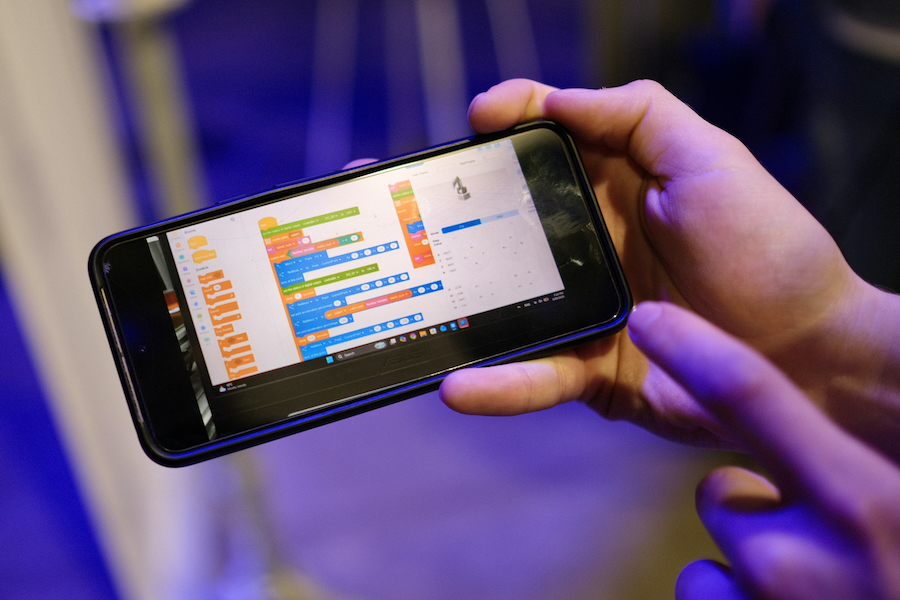
MERCI SPACE - MERCI SPACE is an educational robotics and automation project promoting a modular training and production complex.
Yevhenii Ivanov from MATAS University, a private educational initiative based in Odesa, Ukraine, which focuses on robotics, automation, engineering and modern industrial technologies, explained that MERCI SPACE’s MERC-15 system is an educational and industrial system designed to simulate automated manufacturing processes in line with industry 4.0 and 5.0 standards. The system enables real-world industrial scenarios to be replicated for educational and research purposes, helping users to develop practical skills in robotics, automation and intelligent systems integration.
Based on the open-source LINUX platform and utilising computing hardware from Raspberry Pi, the MERC-15 system allows students to learn about robotics from the ground up by establishing knowledge in the system’s software, firmware and hardware. Yevhenii Ivanov highlighted that by creating a community where educational institutions who the use system(s) share information, the knowledge base about how the software can be coded and the hardware configured continues to grow.
He said: “We integrate it in our universities. You are not controlled by anybody else. You get to define everything...When we provide it in university, we integrate this university community to our global community.”
ADAM - ADAM (AI-Driven Air Monitoring) is an artificial intelligence-powered urban air quality monitoring system for cities. ADAM’s customisable monitoring devices can be placed on electrically-powered vehicles, such as taxis or buses, to provide a moving, dynamic means of collecting real-time pollution data. This data can then be integrated with information from existing, static air pollution sensors to provide the user(s) with a highly detailed overview of a location’s air pollution characteristics.
Sergiy Tkhorenko explained that the data gathered can be used to monitor pollution is specific areas of a city, at a specific time of day. This can then be used to manage traffic flows and infrastructure based on its pollution footprint, allowing city/town planners to restructure and reconfigure urban environments to reduce air pollution. He said: “You can combine this data with existing stationary systems and then you see much more about the city, how it's polluted, how traffic influences it, how you can manage the city or restructure it.”
Sergiy Tkhorenko detailed that the customisable, modular sensors focus on the most common air pollutants (including carbon monoxide, nitrogen dioxide, sulphur dioxide and various sizes of particulate matter) but other sensors can be developed to detect other specific pollutants but are these dependant on cost.
Looking to the future, Sergiy Tkhorenko said that a new stage of development will see a move towards providing predictive information. He said: “We will have our cloud-sourced server which will be collecting and making the data available on a website. We will house this data and then make some predictions. In time, you will get more and more data and you can see how it could be used for prediction in one day, three days, seven days.”