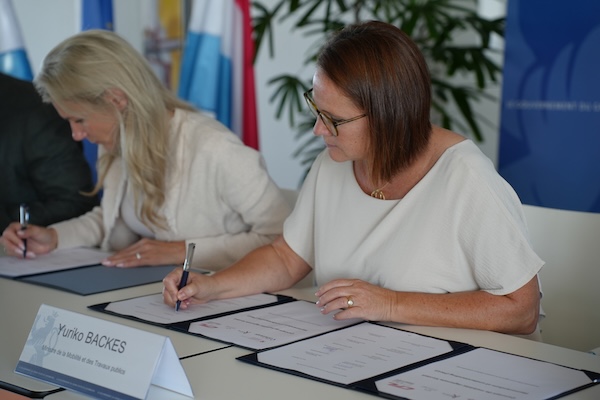
 (L–R) Nadine Braconnier, Mayor of the Municipality of Käerjeng; Yuriko Backes, Luxembourg Minister of Mobility and Public Works;
Credit: MMTP
(L–R) Nadine Braconnier, Mayor of the Municipality of Käerjeng; Yuriko Backes, Luxembourg Minister of Mobility and Public Works;
Credit: MMTP
On Tuesday 6 October 2026, Luxembourg’s Ministry of Mobility and Public Works announced the signing of a memorandum of understanding between the ministry, the municipalities of Differdange, Käerjeng, Pétange and Sanem and mobility stakeholders to develop a coherent, multimodal and sustainable mobility system capable of supporting the area's long-term growth and attractiveness.
The ministry said the signing of this Memorandum of Understanding (MoU) marks a new stage in cooperation between the ministry and the four municipalities of Kordall. The memorandum is the culmination of the “Kordall” regional mobility study, which identified the area's current and future needs. It reflects a shared commitment to anticipating the area's future needs and coordinating the planning of its mobility development. The study's conclusions establish a shared strategic framework and an overall multimodal concept aimed at sustainably improving quality of life and accessibility in this rapidly developing region.
“Tomorrow's mobility is being built today. With this memorandum of understanding, we are establishing a common framework to anticipate changes in the area and coordinate our joint actions. This approach reflects our conviction that the major mobility challenges can above all be addressed through consultation, cooperation and a shared vision for the future,” said Yuriko Backes, Minister of Mobility and Public Works, at the signing ceremony.
The ministry detailed that the Kordall region, comprising the municipalities of Differdange, Käerjeng, Pétange and Sanem, is one of the main development hubs in south-western Luxembourg. With nearly 84,000 inhabitants, strong economic momentum and a strategic position in national and cross-border exchanges, it faces growing mobility challenges that require a coordinated response to ensure its accessibility and support its future development.
A shared vision serving the population and the economy
The memorandum of understanding formalises the partners' joint commitment to implementing, in a coordinated manner, the projects and measures arising from the “Kordall” regional mobility study and to developing coherent mobility solutions across the region.
The overall multimodal concept is based on three complementary areas of action:
⁃ Motorised individual transport: improve accessibility across the region through a better-structured regional road network, while relieving urban centres of through traffic and promoting calmer traffic flows in built-up areas;
⁃ Public transport: encourage a shift from cars to public transport by increasing its attractiveness and improving services to the main residential, employment and service hubs;
⁃ Cycling: develop a safe, direct and connected regional cycling network to encourage cycling as a means of everyday transport.
A long-term commitment
The ministry said the MoU establishes a shared framework for the coordinated implementation and monitoring of the projects under the overall multimodal concept.
The ministry confirmed it will coordinate the monitoring and consultation process, which will take place at least once a year to ensure strategic monitoring of the programme and, where appropriate, adapt its implementation.