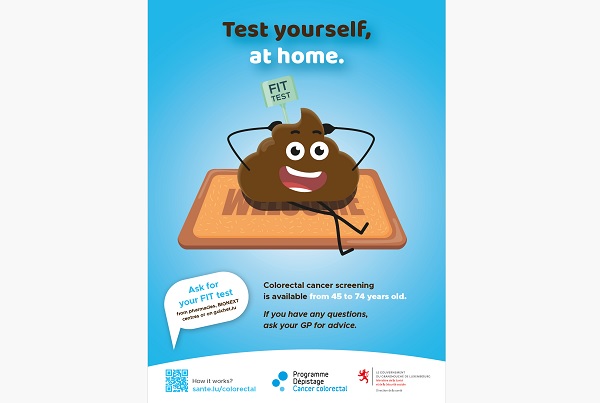
 Credit: MSSS
On Monday 2 March 2026, Luxembourg’s Ministry of Health and Social Security marked “Blue March”, the colorectal cancer awareness month, by reminding the public of the importance of early screening for the disease, which is among the most common cancers in the country.
According to the ministry, approximately 300 new cases of colorectal cancer are diagnosed each year in Luxembourg. The disease affects both women and men and remains one of the leading causes of cancer-related deaths, although it can often be prevented or detected at an early stage. When identified early, colorectal cancer can be treated more effectively, improving recovery prospects and reducing the need for more intensive treatment.
The organised colorectal cancer screening programme is open to women and men aged 45 to 74 who are affiliated with the National Health Fund (CNS), regardless of whether they reside in Luxembourg. Eligible individuals receive an invitation to participate every two years. Non-residents affiliated with the CNS may also take part by contacting the Coordination Centre for Cancer Screening Programmes.
Screening is carried out using a faecal immunochemical test (FIT) designed to detect occult blood in the stool. According to the ministry, the test is simple, can be performed at home and requires no prior preparation or specific dietary measures. The screening kit is available free of charge via Guichet.lu, by telephone through the Bionext laboratory, in pharmacies, or is automatically sent to those who have previously participated in the programme. Once completed, the test can be returned by post or deposited at an authorised collection centre, with results communicated directly by the laboratory. In the event of a positive result, individuals are advised to consult their general practitioner to determine whether a diagnostic colonoscopy is required.
In 2025, 91,350 people were invited to take part in the programme and 31,725 completed the test. Of these, 30,259 results were negative and 1,466 were positive, requiring further examinations such as a colonoscopy to confirm or rule out the presence of cancer or precancerous lesions, according to the ministry.
While many people respond positively to the screening invitation, a significant proportion still needs to be reached to achieve broader coverage. Colorectal cancer develops slowly and often without pain or digestive symptoms, arising from lesions known as polyps which may bleed into the intestine. Such bleeding is not visible to the naked eye, underlining the importance of the test.
“Colorectal cancer screening is a simple, quick and accessible measure that can truly save lives. In case of doubt, do not hesitate to contact your trusted doctor for further information,” said Martine Deprez, Luxembourg’s Minister of Health and Social Security.