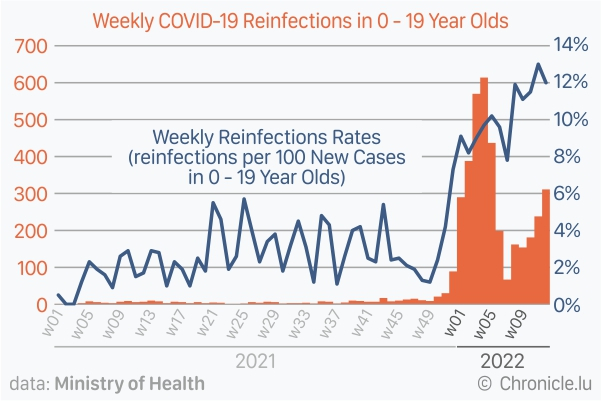
Between January and March 2022, every one in ten new COVID-19 cases in Luxembourg were "reinfections", data communicated to Chronicle.lu shows.
Reinfection cases are classified as those cases which had two PCR confirmed SARS-CoV-2 positive tests separated by at least 90 days.
In the first twelve weeks of 2022, that is between Monday 3 January and Sunday 27 March 2022, a total of 105,902 new COVID-19 cases were detected in Luxembourg, 1.8 times higher than the whole of 2021 (58,613 cases). The number of new COVID-19 cases since January 2022 coincided with the emergence of the Omicron variant, which is a highly transmissible SARS-CoV-2 variant and, owing to its significant deviation from the original SARS-CoV-2 sequence, which can evade post-infection or vaccine-induced immunity. The Omicron variant poses a higher risk of reinfections in unvaccinated as well as fully vaccinated individuals.
In 2021, 11.82% of all children and young people under the age of 20 were infected with COVID-19, marginally higher than 8.54% for the rest of the resident population aged 20 or above. However, in the first quarter of 2022, which was also when the Omicron variant was the dominant and almost exclusive variant in Luxembourg, 27.16% of all children and young people under the age of 20 in Luxembourg tested positive for COVID-19, nearly double than that of 13.87% of the residents aged 20 or above.
This confirmed that children and young people were more affected by the current wave of COVID-19 infections.
Since children below the age of five are not eligible for COVID-19 vaccination and according to the European Centre for Disease Prevention and Control (ECDC), only 49% of children and young people aged five to seventeen in Luxembourg had at least a first dose of a COVID-19 vaccine as of the end of March 2022, Chronicle.lu reached out to the Ministry of Health to learn more about reinfections in children and young people in Luxembourg.
The data showed that 428 children and young people were reinfected in 2021, representing 0.32% of all children and young people. This is similar to 0.36% (1,816) of reinfections in people aged 20 or older. However, in the first twelve weeks of 2022 alone, 3,611 children and young people were reinfected, representing 2.69% of all children and young people. This is considerably higher than 1.65% (8,240) reinfection cases in the rest of the population in the same period.
Since the number of new cases varied each week, the number of reinfections per 100 cases were also calculated as the "weekly reinfection rates". The 428 reinfections in children and young people in 2021 represented an average weekly reinfection rate of 2.6% with respect to all cases in this age group, which increased to 10.3% (3,611) in the first twelve weeks of 2022, similar to the 11.7% (8,240) average weekly reinfection rate in the case of residents aged 20 or above.
Overall, the data indicates that the Omicron variant had nearly a fourfold higher weekly reinfection rate on average in children and young people under the age of 20 compared to earlier variants of SARS-CoV-2, while the weekly reinfection rates are similar for the whole population in the first quarter of 2022 - at around 11.2%.
All calculations were performed according to the resident population as on 1 January 2021.