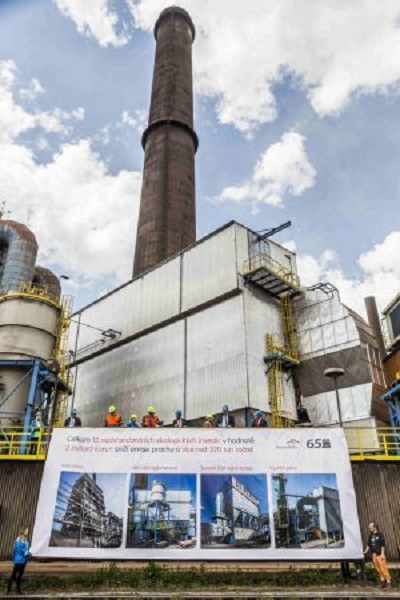
On Wednesday 11 May 2016, ArcelorMittal announced that new technologies worth US$84m have been installed at the company's Ostrava site in the Czech Republic.
Czech Minister of Industry, Jan Mládek, and Minister of Environment, Richard Brabec, visited the site on Tuesday to officially commission the 13 environmental investments which comprise the largest made at the plan in the past five years. The steel plant produces more than 2 million tonnes of steel a year.
The new technology will enable an additional 530 tonnes of dust emissions to be captured annually and the plant's overall particulate-based stack emissions will see a drop to one quarter compared with 2003, when the Ostrava mill joined ArcelorMittal, indicating a reduction to the lowest level in the mill's history. The new filters will also capture emissions of dioxins and benzo(a)pyrene.
As the technology goes beyond emission requirements set by the European Union, the Ostrava branch of ArcelorMittal has received EU subsidies worth around UD$67m, or 1.6bn in Czech currency, to support the project.
"I am honoured to take over this plan in such an excellent condition," commented Vijay Mahadevan, new CEO and chairman of the board of directors of ArcelorMittal Ostrava. "It met European [emissions] limits as early as 2012 but it continued investing in the further reduction of its environmental footprint."
Minister of the Environment, Richard Brabec, added: "I am convinced that the installation of the cutting-edge best available techniques in ArcelorMittal Ostrava and the lowering of dust emissions by 520 tonnes a year will contribute to a better air quality in the Moravian-Silesian Region, especially when added to other measures that the Ministry of Environment has implemented in the region in the long term."
"The steel industry is important to the Czech economy," explained Minister of Industry and Trade, Jan Mládek. "I believe that environmental investments worth billions will offer a competitive edge to Czech companies operating on the international market in the future, even though now [these investments] require extra expenditure and cost competitiveness risks with respect to companies whose environmental standards are not as high. I am pleased that today, I have seen the future of this industry."
Photo by ArcelorMittal